
How Do I Get My Law Firm in the News?
Law firm public relations earns press coverage through genuine news value and real journalist relationships, not press release blasts. Editors publish stories from sources they trust, and they ignore most mass pitches. A firm gets in the news by offering a timely angle, a quotable attorney, and a pitch written the way reporters actually work.
Advertising tells prospective clients you are good. Press coverage lets someone else say it. When a news outlet quotes you as a legal expert or a publication profiles your firm, that coverage carries a kind of credibility paid advertising cannot.
Toppe Consulting is a digital marketing agency in South Carolina, working exclusively with solo practitioners and small law firms. Our law firm public relations practice is led by Joe Toppe, a globally syndicated journalist who spent years inside major newsrooms making editorial decisions. He pitches stories the way he once wanted to receive them.

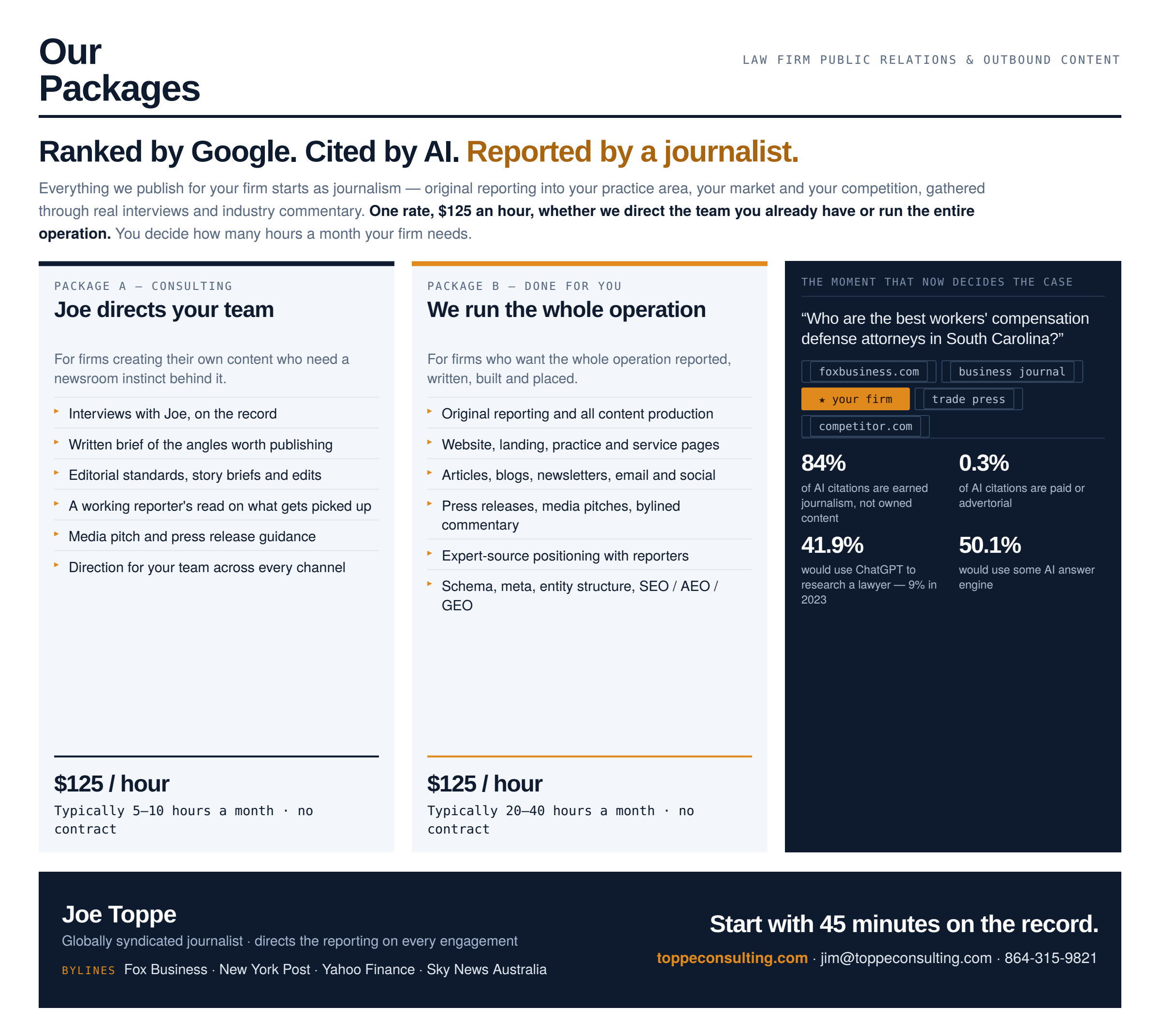
Law Firm Public Relations Packages and Pricing
Both packages are billed at $125 per hour, month to month, with no contract. You can start small and scale up without renegotiating.
| Package | Rate and typical hours | Best for | Includes |
|---|---|---|---|
| Consulting: Joe directs your team | $125 per hour, typically 5 to 10 hours a month | Firms creating their own content that need a newsroom instinct behind it | Interviews with Joe, on the record; a written brief of the angles worth publishing; editorial standards, story briefs, and edits; a working reporter’s read on what gets picked up; media pitch and press release guidance; direction for your team across every channel |
| Done for you: we run the whole operation | $125 per hour, typically 20 to 40 hours a month | Firms that want the whole operation reported, written, built, and placed | Original reporting and all content production; website, landing, practice, and service pages; articles, blogs, newsletters, email, and social; press releases, media pitches, and bylined commentary; expert-source positioning with reporters; schema, meta, entity structure, and SEO, AEO, and GEO |
What Every Toppe Consulting Law Firm Public Relations Engagement Covers
- Attorney press release service with real news angles and proper AP style formatting
- Media pitching that positions your attorneys as expert sources in their practice areas
- Crisis communications managed by a journalist who has handled breaking news from inside a newsroom
- Legal thought leadership strategies built around expert commentary and bylined articles
- Attorney reputation management when coverage goes wrong
- Digital PR that earns links and mentions from credible publications
Contact Us Today to Get Started
How Much Does Law Firm PR Cost?
Toppe Consulting bills law firm public relations at a single rate of $125 per hour, with no contract. A consulting engagement, where Joe directs your team, typically runs 5 to 10 hours a month. A done-for-you program typically runs 20 to 40 hours a month. A smaller firm can start with a few hours and scale up without renegotiating.
Additional Services That Amplify Your PR Coverage
Press coverage works best when every surrounding channel reinforces it. Toppe Consulting connects every additional service to your PR strategy, so each placement supports the rest of your digital presence.
Law Firm SEO. Coverage in credible publications can earn links and mentions that support search rankings. Those same third-party mentions give AI platforms independent sources to verify your firm.
Law Firm Answer Engine Optimization. AI platforms tend to trust firms that credible publications already reference. Press placements give ChatGPT, Perplexity, and Google AI more independent sources to draw on when potential clients ask legal questions.
Law Firm Content Writing. Thought leadership and press coverage share the same requirement — content that demonstrates verifiable expertise at a journalist’s standard. Our team produces every piece to the same AP style and E-E-A-T benchmarks Joe applies across every PR engagement.
Law Firm Digital Marketing Solutions. Our digital marketing team connects your press coverage to your website, paid search, and social media, so each placement reaches more of the people who matter to your firm.
Law Firm Public Relations: What the Trust Data Shows
About 70% of U.S. adults say they have at least some trust in the information they get from local news organizations, and 56% say the same of national news organizations, according to a September 2025 Pew Research Center survey.
That is why local and regional coverage matters so much for a small firm. A quote in the local paper or a regional business journal reaches readers through a source most of them already trust. Every statement in that coverage still has to follow your state’s advertising rules.
How Does Trade Press Coverage Affect a Law Firm’s Client Acquisition?
Trade press coverage builds authority a firm cannot create by promoting itself. When a prospect sees an attorney quoted in an industry publication, the praise comes from an outside voice. Reviews speak to client satisfaction, and media coverage speaks to expertise. Firms that build both give prospects two independent reasons to call.
How Law Firm Public Relations Strengthens SEO and AI Search Visibility
Consistent press coverage can help your firm in three places at once: with readers, with Google, and with AI tools. Links and mentions from credible publications are one of the ways Google judges a site’s authority. AI platforms that power answer engine optimization and generative engine optimization for law firms draw on trusted media sources when they describe and recommend attorneys.
That makes law firm public relations part of your search strategy, not a standalone tactic. Each placement adds another credible, independent source that describes your attorneys as experts.
How Does a Globally Syndicated Journalist Lead to Better Press Coverage for Law Firms?
A globally syndicated journalist knows what makes a story worth covering, what makes a source quotable, and what makes an editor answer the phone. Joe Toppe leads our law firm public relations practice, applying his newsroom experience at Fox Business Network, PropertyCasualty360, and Capital.com to every pitch we send.
Selected reporting by Joe Toppe:
- GM authorizes $10 billion share repurchase to benefit shareholders following strike — Fox Business
- Tesla sets date for Cybertruck event: What to know — Fox Business
- Oil prices bubble ahead of OPEC meeting — Fox Business
- State Farm reaches settlement on 17% rate hike for California homeowners — PropertyCasualty360
- The average American now spends nearly half their annual income on house bills — PropertyCasualty360
Browse his full archives at Fox Business and BenefitsPRO, or review his verified Muck Rack journalist profile.
Why Toppe Consulting for Law Firm Public Relations
Law firm PR is judged by what appears in print, not by how many releases go out. That is why Toppe Consulting’s PR practice is run by a working journalist.
Joe Toppe is a globally syndicated journalist who has spent his career in the rooms where editorial decisions get made. His career includes Associate Producer and Writer at Fox Business Network in New York, Senior Business Journalist at Capital.com, Managing Editor of Innovation and Tech Today, and Managing Editor at PropertyCasualty360.com. His byline has appeared in Yahoo Finance, the New York Post, and Sky News Australia. When Joe pitches a story, he writes it the way an editor wants to receive it. See Joe’s full journalism background and bylines.
Frequently Asked Questions About Law Firm Public Relations
How is legal PR different from general PR?
Legal PR has to follow your state’s lawyer advertising rules. Claims about case results and certain testimonials carry compliance risk, even in press coverage. Legal PR also takes someone who can pitch legal stories credibly and coach attorneys to give clear, quotable statements that reporters use and call back for.
What kind of media placements can a law firm realistically earn?
That depends on your practice areas, your local market, and the news value your attorneys bring. Most firms start with local media and regional business publications. Attorneys in practice areas tied to active news, such as personal injury, criminal defense, and employment law, tend to find openings more often. Relationships with reporters build over time.
How long does it take to earn press coverage?
No one can promise when a reporter will run a story. Timing depends on the news cycle, your practice area, and how strong the angle is. A timely pitch can land quickly, while steady coverage usually builds over months as reporters come to know your attorneys as reliable sources.
Do bar advertising rules apply to press coverage?
Often, yes. Statements your firm makes to promote itself can fall under your state’s lawyer advertising rules, even when they appear in a publication rather than a paid ad. We review every pitch, release, and quote against your state’s requirements before anything goes out.
How does PR connect to SEO and AI search visibility?
Coverage in credible publications can earn links and mentions that support your search rankings. It also gives AI platforms such as ChatGPT, Perplexity, and Google AI independent sources to draw on when they describe or recommend attorneys. That is why PR and search work best when one team plans both.
Law Firm Public Relations Builds Authority Your Other Channels Can Use
Advertising tells prospective clients you are good. Law firm public relations lets the publications they already trust say it. Each placement adds an independent voice behind your attorneys, for readers, for Google, and for AI tools. Toppe Consulting does that work at $125 per hour, with no contract.
Recent Industry News

Need Content Written by a Human? Meet Joe Toppe

Your Next Client Is Already Searching. Educational Content Is How They Find You.

Greenville’s Bar Is 126 Years Old. Charleston’s Was Already 201 When It Opened

AALS Convenes National Task Force as the Rules for Becoming a Lawyer Come Apart