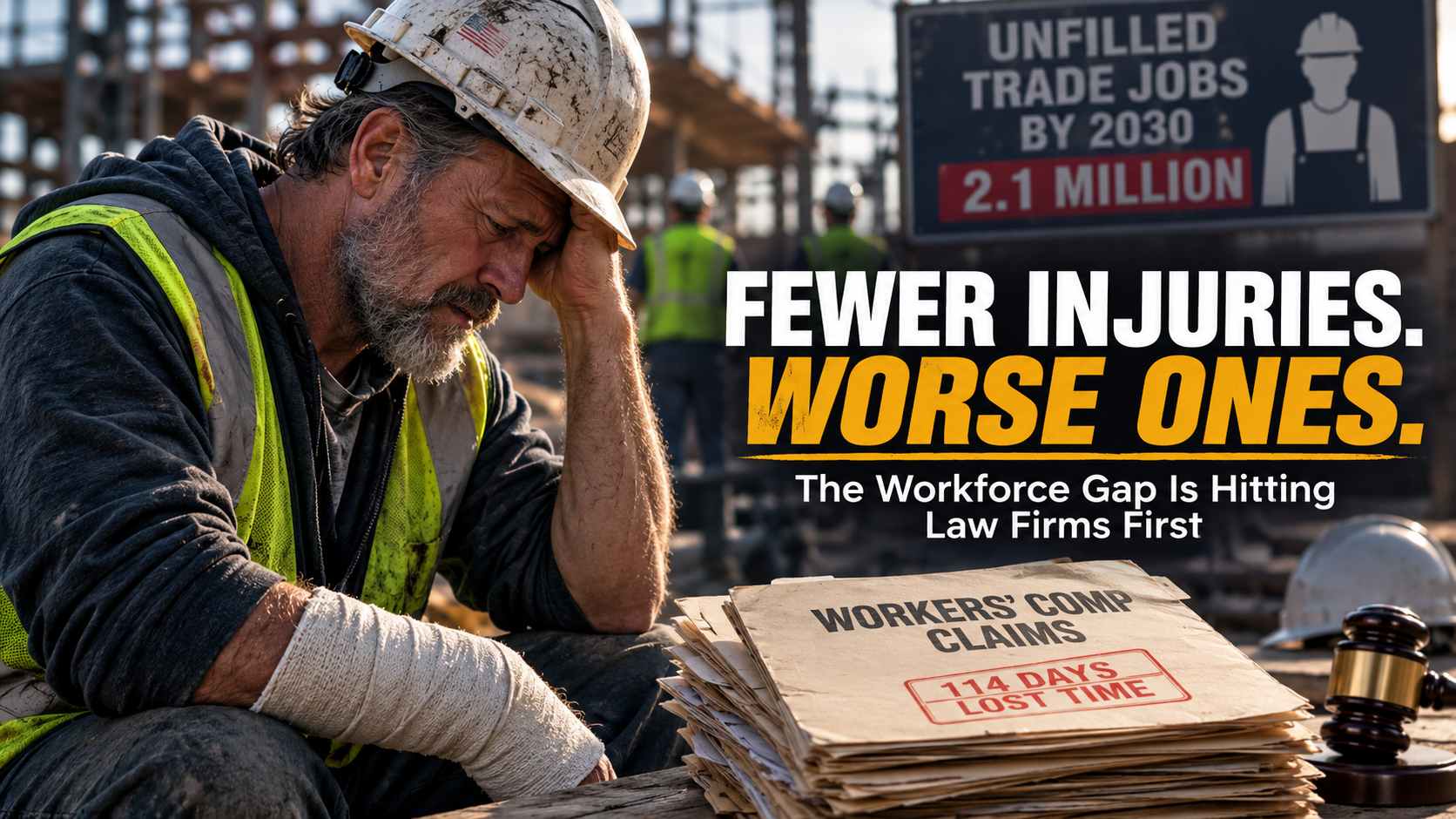
Workers Compensation Lawyer Digital Marketing
Injured workers need attorneys who will fight for their benefits. Your potential clients are dealing with pain, lost wages, and insurance companies that don't want to pay. Your marketing needs to offer hope and action.
Home Digital Marketing and Public Relations for Law Firms Law Firm Practice Areas Served Workers compensation lawyers
How Do I Sign More Workers Compensation Cases From the Internet?
Workers compensation digital marketing combines SEO, website design, AEO, GEO, and public relations into one coordinated system that signs cases. Furthermore, every channel must reach injured workers at the moment they search — not after competitors already have. Consequently, scattered tactics produce activity reports while integrated execution produces signed retainers.
Why Workers Comp Firms Cannot Afford Fragmented Digital Marketing
The firm running SEO without a conversion-ready website bleeds leads. The firm with a beautiful site but no AI visibility loses cases to competitors cited by ChatGPT. Consequently, workers compensation digital marketing only works when every channel feeds the next. Searches for “hurt at work lawyer” land on pages. Those pages earn citations. Citations earn press. Press earns rankings. Furthermore, firms that coordinate every channel dominate local markets while fragmented competitors wonder why their traffic stalls. Toppe Consulting builds every workers comp campaign to treat the entire funnel as one connected system — not a stack of disconnected marketing tactics.
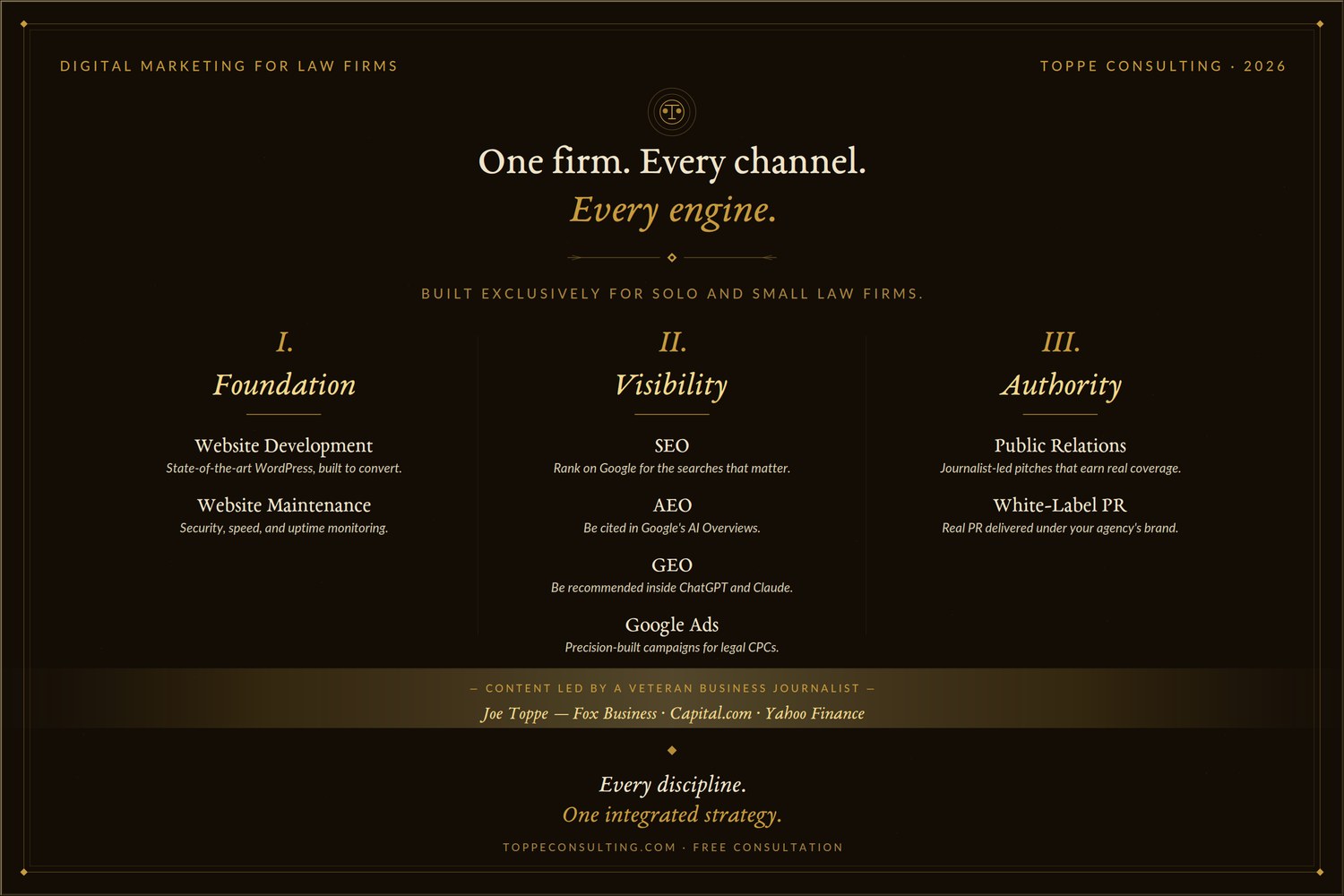
What Workers Compensation Digital Marketing Delivers
- SEO campaigns that capture “workers comp lawyer near me” and “denied workers comp claim” searches in your exact service cities
- Conversion-focused website design built to turn urgent injured-worker searches into signed intake calls
- Answer engine optimization that earns citations in ChatGPT, Perplexity, and Google AI Mode responses
- Generative engine optimization that positions your firm inside AI-generated legal answers
- Public relations campaigns that land press placements in insurance, legal, and workers comp trade publications
- Cross-channel reporting that tracks rankings, organic leads, AI citations, press hits, and cost-per-signed-case
What Does Workers Compensation Digital Marketing Do
Workers compensation digital marketing does what no single channel can do alone. It surrounds an injured worker at every point where they look for help — Google, ChatGPT, Perplexity, trade press, and the firm’s own website. Consequently, the firm stays visible whether the searcher types into Google at 2 AM or asks Claude for a lawyer recommendation at lunch.
The practical mechanics span five disciplines. Our workers compensation SEO program captures organic search traffic. Meanwhile, workers compensation website design services turn that traffic into calls. Answer engines matter too — workers compensation AEO and workers compensation GEO practices earn citations in AI-generated responses. Finally, workers compensation public relations earns press coverage that compounds every other channel.
Additionally, strong campaigns treat each channel as feedstock for the next. A press mention builds SEO authority. Authority lifts rankings. Rankings drive citations in AI answers. AI visibility drives conversion. Furthermore, skipping any single channel breaks the loop. That is why Toppe Consulting runs every workers comp campaign as one integrated program rather than five disconnected engagements.
How Do Injured Workers Research Lawyers Today?
Injured workers research attorneys across multiple channels within hours of an injury. They start with Google searches like “hurt at work lawyer.” Then they check reviews, scan firm websites, and increasingly ask ChatGPT or Perplexity for recommendations. Consequently, any firm missing from even one of those channels loses the case to a competitor that shows up everywhere.
Why Workers Compensation Digital Marketing Matters
The Bureau of Labor Statistics reported 2.5 million nonfatal workplace injuries and illnesses in 2024 — each one a potential case. Additionally, the top three Google results capture 54.4 percent of all clicks, and AI Overviews now appear in more than 60 percent of U.S. Google searches. Consequently, a firm visible in only one channel competes against firms visible in all of them.
Paid ads deliver immediate leads. However, organic rankings, AI citations, and press authority compound over time and cost dramatically less per lead once established. SEO leads close at 14.6 percent compared with 1.7 percent for outbound efforts, according to widely cited HubSpot data. Furthermore, coordinated channels produce a multiplier effect that single-channel campaigns cannot match.
Workers comp cases are also won and lost locally. Google Business Profile visibility, local press coverage, and city-specific content all feed the map pack. A firm coordinating all of it across SEO, website design, AEO, GEO, and PR dominates its service cities. Meanwhile, competitors running one channel at a time watch their rankings stall.
Is One Channel Enough for a Workers Comp Practice?
No. A single-channel strategy leaves 60 to 80 percent of potential clients unreached. Injured workers use Google, AI engines, review sites, and social platforms — often within the same research session. Additionally, AI search now intercepts traffic that SEO alone would have captured. Furthermore, firms running only one channel lose visibility to competitors covering every channel simultaneously.
How Workers Compensation Digital Marketing Works
Every campaign starts with an audit across all five disciplines. We map current SEO visibility, website conversion performance, AI citation presence, press footprint, and competitive positioning. Moreover, that audit reveals which channel is weakest — and therefore where the firm is losing the most cases.
Strategy follows the audit. We prioritize the channel with the highest return-to-effort ratio for the firm’s specific market. Additionally, every channel gets integrated into the same editorial calendar so content produced for SEO feeds AI answers, powers press pitches, and supports website conversion copy. Every piece of content earns its keep across multiple channels.
Execution runs monthly. SEO content goes live. Website conversion elements get tested. AI platforms get monitored for citation opportunities. Press pitches land in trade publication inboxes. Furthermore, reporting ties every channel to signed-case outcomes — not vanity metrics. These principles apply across the full discipline of law firm digital marketing solutions. Our team calibrates every campaign specifically for workers comp.
Why Does Channel Integration Matter More Than Channel Volume?
A firm running five channels independently wastes budget on overlap and misses opportunities at the seams. Consequently, integration matters more than volume. A press placement that feeds SEO authority, powers AI citations, and drives website conversion returns three times the value of the same placement working in isolation. Moreover, AI platforms reward firms with coordinated signals across channels.
Industry Verticals That Drive Workers Comp Volume
Three industries generate the majority of workers compensation case volume — construction, manufacturing, and healthcare. Each brings distinct injury patterns, search language, and media footprints. Consequently, digital marketing campaigns that ignore vertical differences leave cases on the table.
Construction cases involve falls, equipment accidents, and scaffolding collapses. Manufacturing cases skew toward repetitive motion, machine injuries, and chemical exposure. Healthcare cases center on back injuries, needlestick exposure, and patient-handling injuries. Additionally, each vertical reads different trade publications, uses different search vocabulary, and responds to different ad creative.
AI search has compounded the vertical differences. ChatGPT answers construction injury questions with different source citations than it uses for healthcare injuries. Furthermore, Perplexity and Google AI Mode weight trade publications heavily — meaning a firm cited in Construction Dive outranks a firm cited only in general legal publications. Our integrated campaigns earn vertical-specific visibility across every channel.
Does Integrated Digital Marketing Work for Smaller Firms?
Yes. Smaller workers comp firms actually benefit more from integration than larger firms do. Consequently, coordinating five channels around a focused practice outperforms a generalist firm spreading budget across ten practice areas. Additionally, smaller firms move faster, respond to leads quicker, and adapt campaigns in real time — all ranking and conversion advantages.
Choosing the Right Workers Compensation Digital Marketing Partner
Most legal marketing agencies silo every service. SEO lives on one floor, web design on another, PR in an outside contractor relationship. Consequently, nothing talks to anything else. Press placements never feed SEO strategy. Website copy never reflects what actually ranks. AI citations never get tracked. Moreover, the firm pays five vendors for what should be one coordinated program.
Toppe Consulting operates differently. Our Content Director, Joe Toppe, is a working journalist. He currently serves as Managing Editor at PropertyCasualty360 — a leading trade publication covering insurance, claims, and workers compensation. Additionally, Joe spent years as Associate Producer and Writer at Fox Business Network in New York. He later served as Senior Business Journalist at Capital.com and Managing Editor at Innovation & Tech Today. Joe’s byline has appeared in Yahoo Finance, the New York Post, and Sky News Australia. He holds a Master’s Degree in Journalism and Mass Communication from Kent State University.
That matters for workers comp digital marketing directly. Every channel we run — SEO, website design, AEO, GEO, PR — gets built by a team led by a journalist whose daily beat covers this industry. Workers comp firms receive the direct benefit. Furthermore, editorial instincts, source relationships, and claims-ecosystem knowledge shape every piece of content, every page of copy, and every pitch we produce.
Frequently Asked Questions About Workers Compensation Digital Marketing
How long does it take for workers compensation digital marketing to produce results?
Paid channels produce leads immediately. SEO, AEO, and GEO typically show measurable progress within 90 to 120 days. Additionally, press-driven authority compounds over 6 to 12 months. Furthermore, the integrated approach produces faster overall results because each channel accelerates the others — rather than working in isolation.
Do I have to buy all five services at once?
No. Most firms start with the channel showing the biggest gap in their current marketing. Consequently, that often means SEO or website design first. Additionally, we build every campaign so new channels plug in later without reworking existing content. Furthermore, firms can scale the program as budget allows.
How does this work with Google Ads or paid search?
Paid channels fit into the integrated strategy as a sixth layer. Search terms that convert in ads inform SEO content priorities. Moreover, landing page performance data shapes website design decisions. Consequently, most firms run paid and organic channels together — with paid delivering immediate volume while organic channels compound returns.
Is workers compensation digital marketing affected by AI search?
Yes, significantly. AI search now intercepts queries that traditional SEO alone would have captured. Consequently, firms without AEO and GEO lose visibility that paid and organic channels cannot recover. Furthermore, answer engines prioritize firms with strong editorial quality, verifiable expertise, and third-party media references — exactly what integrated campaigns produce.
What makes Toppe Consulting different for workers comp firms?
Our Content Director, Joe Toppe, runs day-to-day operations as Managing Editor at PropertyCasualty360. The publication leads coverage of insurance, claims, and workers compensation. Consequently, a working journalist whose daily beat covers this industry shapes every channel we run. Furthermore, his newsroom relationships earn press coverage that compounds every other marketing channel.
Workers Compensation Digital Marketing Is a Compounding Asset
Every month of coordinated optimization adds rankings, citations, press coverage, and authority that do not disappear when a campaign ends. Consequently, firms that invest early outrank competitors who stayed fragmented for years. The question is never whether integrated digital marketing works — it is how soon you connect every channel.
Recent Industry News
Need Content Written by a Human? Meet Joe Toppe

Your Next Client Is Already Searching. Educational Content Is How They Find You.

Greenville’s Bar Is 126 Years Old. Charleston’s Was Already 201 When It Opened

AALS Convenes National Task Force as the Rules for Becoming a Lawyer Come Apart