
Five Retire, Two Replace: The Trades Gap Is Quietly Rewriting Injury Caseloads
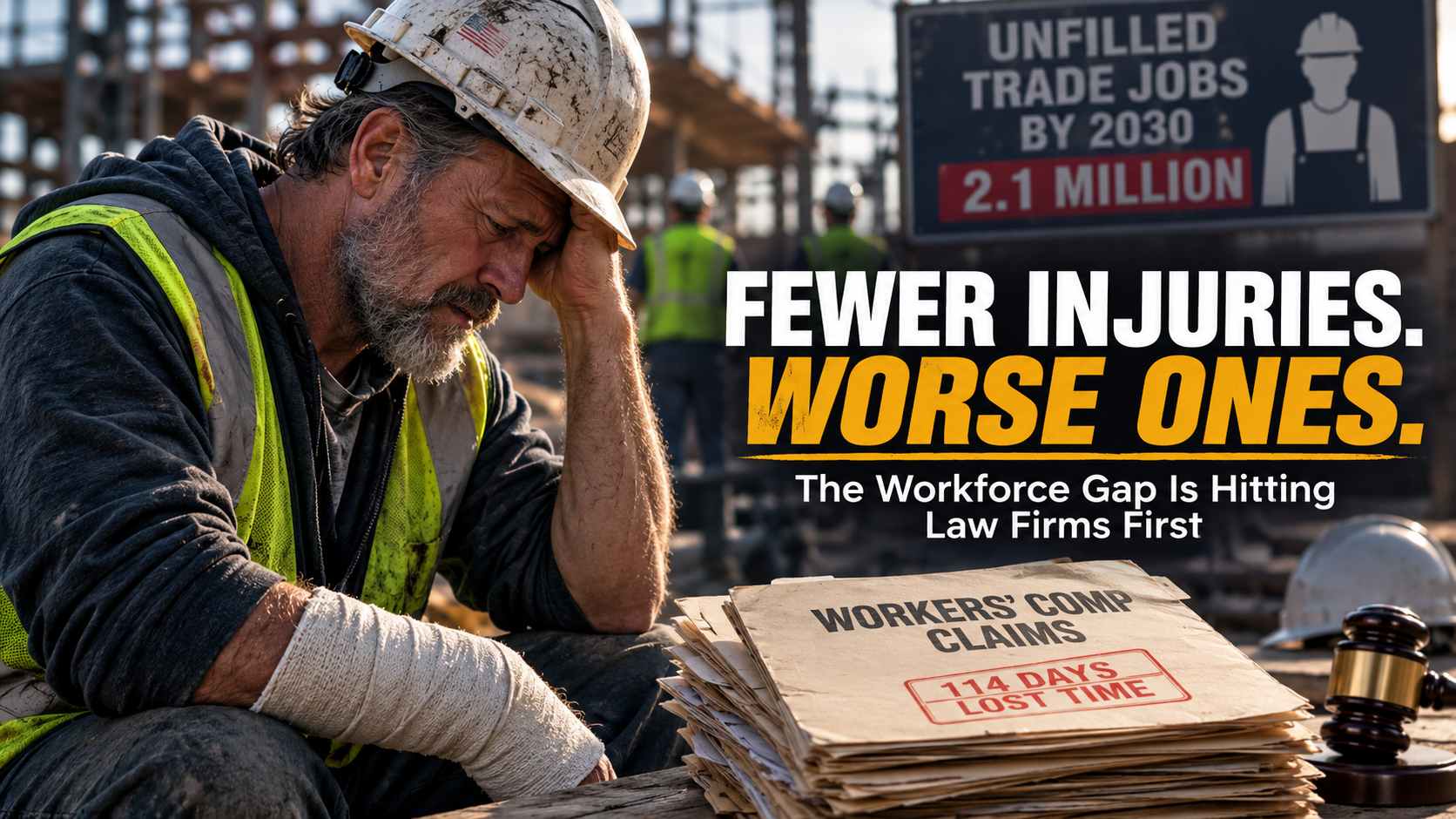
The math is simple and it is brutal. For every five workers who retire from construction, manufacturing and the skilled trades, only two enter to replace them. That estimate comes from the U.S. Department of Education, and commercial real estate firm JLL made it the centerpiece of an April 2026 workforce study projecting 2.1 million unfilled trade jobs by 2030 and potential economic losses reaching $1 trillion annually.
Most coverage treats this as an economics story — delayed projects, higher bids, stalled data centers. That framing misses where the gap lands first.
It lands in claim files.
Fewer Injuries, Worse Ones
Start with the counterintuitive part: workplace injuries are going down. The Bureau of Labor Statistics recorded 5,070 fatal work injuries in 2024, a 4% decline from the prior year, alongside 2.5 million nonfatal injury and illness cases in private industry — down 3.1%.
The injuries that still happen, however, are getting harder.
Travelers released its 2026 Injury Impact Report in May, analyzing more than 1.2 million workers’ compensation claims filed between 2021 and 2025. First-year employees accounted for 44% of all construction injuries and drove 47% of the industry’s compensation claim costs. Injured construction workers missed an average of 114 workdays — the highest figure of any sector studied, and well above the 80-day cross-industry average.
Travelers named the drivers explicitly: an aging workforce and the disproportionate vulnerability of first-year employees. That is the trades gap, described in actuarial terms.
The Pipeline Isn’t Closing It
Employers facing a 5-to-2 gap do not leave work undone. They hire whoever is available and put them on site faster than training cycles were designed to allow.
The U.S. Department of Labor’s Office of Apprenticeship publishes state-level participation and completion data current through mid-2026, and the trend line is genuinely positive. It is also insufficient. Against roughly 600,000 annual skilled trades job postings, only about 150,000 new workers entered through apprenticeship programs in the most recent year measured.
What leaves with the retiring journeyman is not on any dashboard. Which trench needed shoring. Which panel was still hot. Which shortcut killed someone in 1998. That knowledge was never in a manual.
Why This Reaches the Legal Profession
For workers’ compensation, personal injury and construction attorneys, this is a structural shift in caseload composition — not a cyclical bump.
Severity, not frequency, is what generates legal work. A 114-day lost-time claim produces disputes that an eight-day claim never reaches: causation fights, light-duty availability, permanency ratings, settlement valuation. These are the files that require counsel rather than resolving administratively.
Inexperienced crews generate a second tier of exposure as well. Third-party liability against general contractors and equipment manufacturers. OSHA citations that become evidence in negligence theories. Defect claims traced to improper installation by workers who were never adequately trained.
The Visibility Problem
An injured pipefitter does not consult a directory of attorneys. He searches — on his phone, often within days, frequently while still on medical leave.
What he finds is usually a high-volume advertiser with a seven-figure media budget, not the local practitioner who would try his case better. The caseload expansion is real and measurable, but it flows toward whoever occupies the search results.
Firms that have not built visibility around these claim types will watch the surge pass, then hear about it secondhand from an adjuster.
Toppe Consulting: Built for Small Firms Competing Against Big Names
Toppe Consulting works exclusively with solo practitioners and small law firms, applying an investigative-journalism approach to content and search strategy — covering industry shifts like this one the way a newsroom would, then positioning your firm inside the story.
Our Services Include:
- Search Engine Optimization for Law Firms — Content and local search strategy built around how injured workers actually search
- Public Relations for Law Firms — Earned media and thought leadership that establish authority before the case walks in
No long-term contracts. No retainer minimums designed for firms ten times your size.
Ready to be found when the claims arrive? Contact Toppe Consulting for a free consultation.
About the Author
Jim Toppe is the founder of Toppe Consulting, a digital marketing agency working exclusively with solo practitioners and small law firms. He holds a Master of Science in Management from Clemson University, teaches Business Law and Marketing at Greenville Technical College, and is the publisher of South Carolina Manufacturing, a digital magazine.
Works Cited
“Injuries, Illnesses, and Fatalities.” U.S. Bureau of Labor Statistics, U.S. Department of Labor, www.bls.gov/iif/. Accessed 8 Aug. 2026.
“Data and Statistics.” Apprenticeship.gov, Office of Apprenticeship, U.S. Department of Labor, www.apprenticeship.gov/data-and-statistics. Accessed 8 Aug. 2026.
Xie, Wei, and Steven Lewis. “Building Tomorrow’s Workforce Today.” JLL, 21 Apr. 2026. Accessed 8 Aug. 2026.
“Travelers Injury Impact Report Highlights Longer Recovery Times Amid Declining Injury Rates.” The Travelers Companies, Inc., 4 May 2026. Accessed 8 Aug. 2026.
Disclaimer
Toppe Consulting provides digital marketing services to law firms. This article is for informational purposes and does not offer legal advice.
Related Articles
Recent Industry News

Need Content Written by a Human? Meet Joe Toppe

Your Next Client Is Already Searching. Educational Content Is How They Find You.

Greenville’s Bar Is 126 Years Old. Charleston’s Was Already 201 When It Opened
AALS Convenes National Task Force as the Rules for Becoming a Lawyer Come Apart