The 7 Workplace Injuries Behind Most Workers’ Comp Claims, and What Your Firm Should Publish About Each
Toppe Consulting | Building Better Law Practices, One Attorney at a Time
An injured worker rarely searches for a workers’ compensation attorney first. The first search is about the injury. A warehouse worker with a torn shoulder types what happened to his shoulder. A nurse who hurt her back lifting a patient asks whether a lifting injury counts as a work injury. The most common workplace injuries each start their own trail of searches.
That gap matters for every workers’ comp firm with a website. Clients begin with the body part and the accident, not the legal claim. A firm that only publishes pages about its practice area misses the moment a future client first goes looking.
What the Data Shows About Common Workplace Injuries
Private employers reported 2.5 million nonfatal workplace injuries and illnesses in 2024, according to the U.S. Bureau of Labor Statistics release published January 22, 2026. The total fell 3.1 percent from 2023 and was the lowest in the series going back to 2003.
Fewer total cases does not mean fewer serious ones. The National Safety Council’s analysis of 2023–2024 BLS data, updated August 18, 2026, counts 499,270 days-away-from-work cases from contact incidents, 492,140 from overexertion, and 479,480 from falls, slips, and trips. Exposure to harmful substances or environments ranked fourth.
Those categories line up closely with the questions injured workers type into Google and AI search tools. Here are the seven worth building content around.
1. Struck By or Caught in Equipment
Contact incidents led all categories for days away from work in 2023–2024. They include workers hit by falling objects and workers caught in running machinery. These clients often ask whether they can pursue the equipment maker as well as file for workers’ comp. A page that explains the difference between a comp claim and a possible third-party claim answers that question in plain language.
2. Lifting and Overexertion Injuries
Overexertion sat just behind contact incidents. Think of the nurse moving a patient or the warehouse worker lifting a pallet. The searches are specific: “hurt my back lifting at work” or “shoulder injury from lifting boxes.” An FAQ page built around those exact phrases meets the client at the first search.
3. Repetitive Motion Injuries
Carpal tunnel and other repetitive strain injuries fall in the same overexertion category, but they behave differently. There is no single accident date. Many workers are unsure whether a condition that built up over months qualifies at all. A page on how gradual-onset injuries are reported in your state speaks to the doubt that keeps these clients from calling.
4. Slips, Trips, and Falls on the Same Level
Wet floors, loose cables, and uneven surfaces cause injuries in almost every industry. These clients often worry the fall was their own fault. Content explaining how fault is treated in your state’s workers’ comp system addresses the fear that stops many of them from looking for a lawyer.
5. Falls From Ladders, Scaffolds, and Roofs
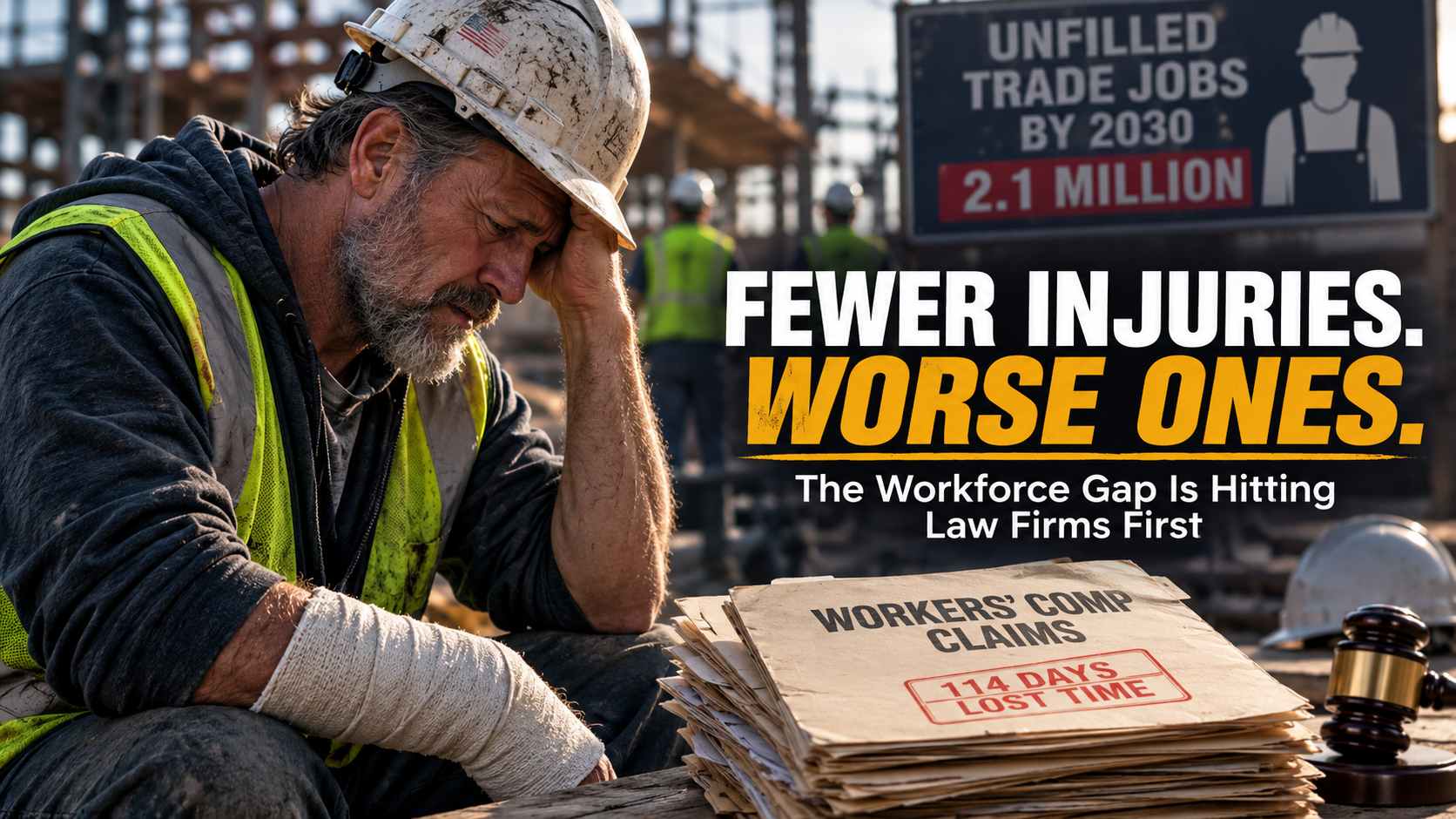
Falls to a lower level concentrate in construction and the skilled trades, where injuries tend to be severe. That workforce is changing fast, as our reporting on how the trades gap is rewriting injury caseloads found. Pages on construction fall injuries should cover long-term disability questions, since these clients often face months away from work.
6. Heat, Chemical, and Noise Exposure
Exposure to harmful substances or environments ranked fourth for days-away cases. The National Safety Council groups temperature extremes, harmful substances, and noise in this category. For firms in hot-climate states, a page on heat-related injury claims gives outdoor workers content written for their situation.
7. Assaults and Workplace Violence
The National Safety Council tracks assault at work as its own safety topic. Many victims think of an assault as a crime, not a work injury, so they never search for a comp attorney. How these claims are handled varies by state. A page explaining whether an on-the-job assault can lead to a workers’ comp claim reaches people who may not know to ask.
Build the Page Before the Search
Each of these injuries starts with a question, and the question comes before the phone call. That is the core of educational content for law firms: write for the client’s first search, not the lawyer’s vocabulary. Keep every page accurate, avoid promising outcomes, and follow your state bar’s rules on case results and disclaimers.
Toppe Consulting: Digital Marketing for Small Law Firms
Toppe Consulting works exclusively with solo practitioners and small law firms. Content is written in-house by Joe Toppe, a Managing Editor at PropertyCasualty360 and former Fox Business Network writer. No long-term contracts, and a clear quote upfront.
Our Services Include:
- Law Firm Content Writing — Practice area pages and articles written by working journalists
- Law Firm SEO — Practice area pages and content built around how clients actually search
Starting from scratch or starting over?
Contact Toppe Consulting for a quote with no contract attached.
Works Cited
National Safety Council. “Top Work-Related Injury Causes.” Injury Facts, 18 Aug. 2026, injuryfacts.nsc.org/work/work-overview/top-work-related-injury-causes/.
U.S. Bureau of Labor Statistics. “Employer-Reported Workplace Injuries and Illnesses – 2023-2024.” U.S. Department of Labor, 22 Jan. 2026, www.bls.gov/news.release/osh.nr0.htm.
Toppe Consulting provides digital marketing services to law firms. This website does not offer legal advice.
Bar advertising rules vary by state and change over time. Confirm current requirements with your state bar.
Related Articles
- Five Retire, Two Replace: The Trades Gap Is Quietly Rewriting Injury Caseloads
- Your Next Client Is Already Searching. Educational Content Is How They Find You.
 About the author:
Joe Toppe is the Content Director for Toppe Consulting, a Managing Editor at PropertyCasualty360, and a former Associate Producer and Writer at Fox Business Network.
Recent Industry News
Need Content Written by a Human? Meet Joe Toppe

Your Next Client Is Already Searching. Educational Content Is How They Find You.

Greenville’s Bar Is 126 Years Old. Charleston’s Was Already 201 When It Opened
AALS Convenes National Task Force as the Rules for Becoming a Lawyer Come Apart