
Generative Engine Optimization for Law Firms
Home Generative Engine Optimization for Law Firms
What Is Generative Engine Optimization for Law Firms?
Generative engine optimization for law firms is the work of making a firm easy for AI tools such as ChatGPT, Gemini, and Google AI Overviews to find, understand, and cite. It covers crawler access, indexing, structured data, consistent firm details, and well-sourced content. The goal is accurate representation when prospective clients ask AI about legal help.
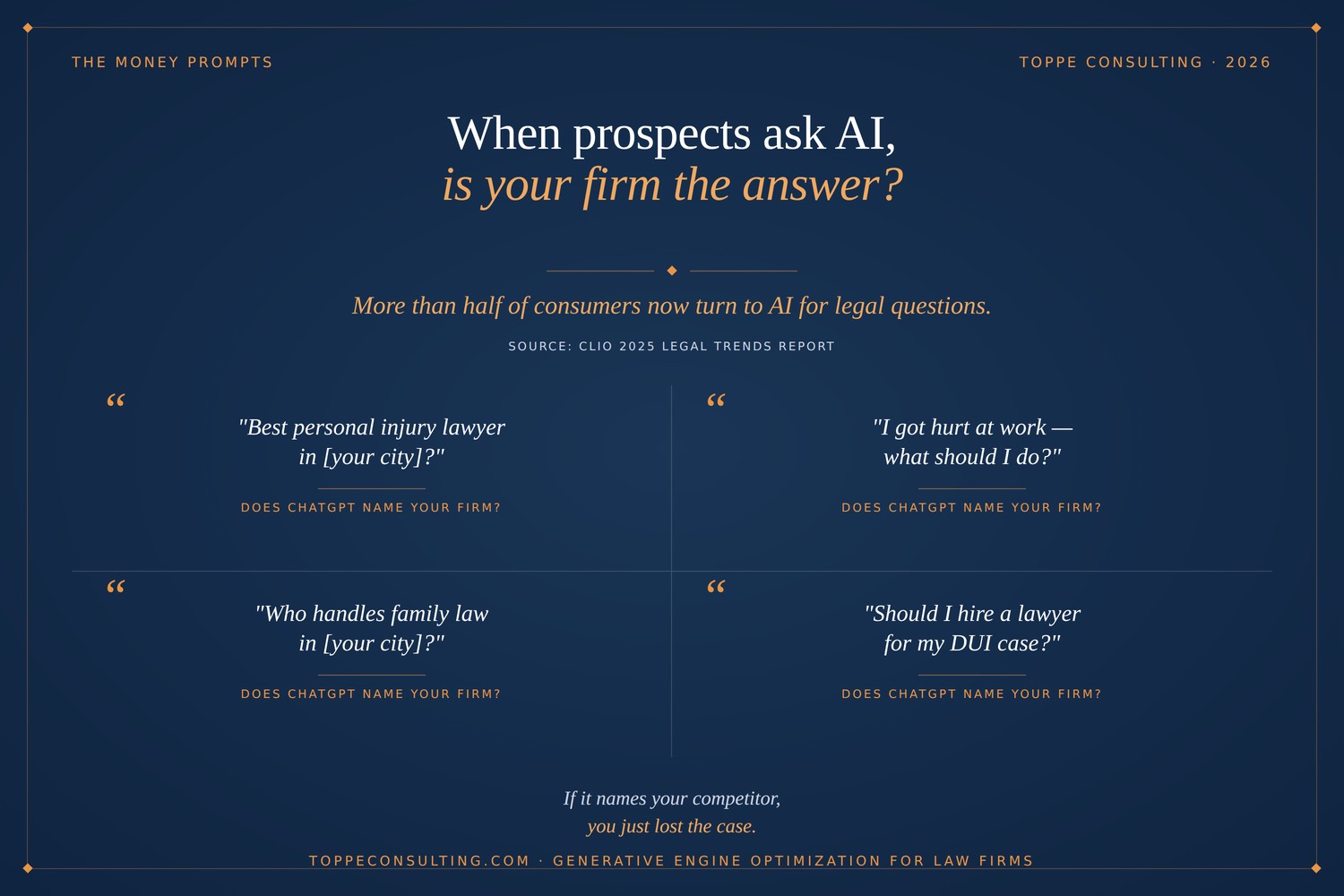
A potential client asks ChatGPT to find a personal injury attorney. Instead of ten blue links, the AI often names a few firms, explains why, and links to the sources it trusts. If your firm is not among those sources, that prospect may never see your name. Toppe Consulting is a digital marketing agency in South Carolina, working exclusively with solo practitioners and small law firms. We build generative engine optimization for law firms around how AI platforms find, evaluate, and cite legal sources, so your firm gives those platforms accurate reasons to include it.
What Every Generative Engine Optimization for Law Firms Engagement Covers
- AI brand audit that assesses how your firm currently appears across major AI platforms
- Schema markup implementation that helps AI systems extract and trust your firm’s information
- E-E-A-T content development built to the same journalism standards applied to every engagement
- Citation and authority building across legal directories, local publications, and professional platforms
- Review of every piece of GEO content against your state’s advertising rules
- Citation tracking that monitors how AI platforms reference your firm across practice areas over time
Contact Us Today to Get Started
How Long Does GEO Take to Produce Results for a Law Firm?
GEO timelines depend on how often AI platforms refresh their sources, how much content needs building, and how competitive your practice area is. Technical fixes such as crawler access, indexing, and schema tend to register first. Third-party mentions and content depth build over months. No agency can predict exactly when a given AI platform will cite a firm.
Additional Options for Your Law Firm GEO Strategy
GEO performs best when the surrounding strategies reinforce it. Toppe Consulting builds every additional service around your GEO foundation so your entire digital presence works together from day one.
Law Firm SEO. Traditional search and AI search draw on many of the same content and authority signals. Google AI Overviews and Gemini lean heavily on pages Google already ranks.
Law Firm Answer Engine Optimization. AEO targets placement inside direct AI responses to specific legal questions your prospective clients ask. It works alongside generative engine optimization, so the same content serves both short direct answers and longer AI-generated responses.
Law Firm Content Writing. AI platforms cite sources with verifiable depth and documented expertise. Our content team produces practice area pages, attorney biographies, and location content built to E-E-A-T standards and your state’s advertising rules.
Law Firm Digital Marketing Solutions. AI visibility is easier to build when every channel tells the same story about your firm. Our digital marketing team coordinates paid search, organic rankings, and AI visibility around the practice areas where your firm competes and the clients you want to reach.
Generative Engine Optimization for Law Firms: What the Consumer Data Shows
About a third of U.S. adults, 34%, say they have used ChatGPT, roughly double the share in 2023, according to a Pew Research Center survey conducted in early 2025. Among adults under 30, the figure is 58%. The same survey found that 26% of U.S. adults have used ChatGPT to learn something new, up from 8% in 2023.
Those are the people who will one day need a lawyer. When they ask an AI tool for help, the answer draws on whatever sources that tool can find and verify. Generative engine optimization for law firms is built to help your firm be one of them.
What Makes an AI Platform Choose One Law Firm’s Content Over Another?
AI platforms tend to cite content that is clearly structured, accurately sourced, and written to answer a specific question. They also weigh credible third-party mentions, such as press coverage and reviews. A firm with a strong local reputation can still be overlooked if its website and outside mentions give AI tools little to verify or quote.
How Generative Engine Optimization Connects to Your Broader Digital Presence
GEO does not replace your existing marketing — it extends it. Your law firm website development provides the content foundation AI platforms draw from. Strong practice area pages, documented attorney credentials, and technical architecture that lets AI systems extract your firm’s information all start with how your site is built.
Outside your site, consistent firm details across directories and listings help AI tools confirm who you are. Press coverage and third-party mentions give them independent sources to cite. That kind of authority takes time, which is why GEO work starts with your foundation rather than shortcuts.
How Much Does GEO Cost for a Law Firm?
GEO cost for a law firm depends on how much content needs building, how competitive the practice area is, and whether technical fixes such as indexing and schema come first. Toppe Consulting gives a clear quote upfront, with no hidden fees and no long-term contracts. You can start with an audit and a smaller scope, then add services later.
Why Toppe Consulting for Generative Engine Optimization
GEO for law firms is more than an add-on to traditional SEO. Legal topics fall under the “Your Money or Your Life” category that search engines treat with extra care, so sources with verifiable credentials and accurate sourcing stand a better chance of being cited.
Toppe Consulting serves one industry: law firms. Joe Toppe leads the content operation. He is Managing Editor at PropertyCasualty360 and a former Associate Producer and Writer at Fox Business Network, with a Master’s Degree in Journalism and Mass Communication from Kent State University. Jim Toppe teaches Business Law and Marketing at Greenville Technical College and brings 10 years of experience in digital marketing for law firms. Every piece is reviewed against your state’s advertising rules before it is published.
Frequently Asked Questions About Generative Engine Optimization for Law Firms
What does a GEO audit for a law firm look at?
A GEO audit checks how ChatGPT, Gemini, Perplexity, and Google AI Overviews describe your firm today. It also checks whether AI crawlers can reach your site, whether Google and Bing have indexed it, and whether your schema and firm details are consistent. The result is a prioritized list of fixes.
How does GEO content earn citations from AI platforms?
AI platforms tend to cite sources with consistent expertise, factual accuracy, and verifiable credentials. Every piece of content we produce for GEO follows journalism ethics standards and targets E-E-A-T, so AI systems have accurate, attributable information to work with. Generic or thin content gives AI platforms little reason to cite a firm. Depth, accuracy, and documented expertise give them more.
Can GEO and traditional SEO run simultaneously?
Yes, and they work best when one team coordinates both. The content and authority signals that support GEO also support traditional search rankings. Our SEO and GEO work runs from one plan, so the same pages serve both Google and AI-powered search, without duplicated effort.
Does my existing website content support GEO?
It depends on the quality and depth of your existing content. Thin practice area pages, sparse attorney biographies, and content without real expertise signals give AI platforms little to cite. We audit your existing content during GEO onboarding and identify what needs work first.
Do bar advertising rules apply to GEO content?
Yes. Your state’s Rules of Professional Conduct govern lawyer advertising, and they apply to AI visibility content the same way they apply to your website. We review every piece of GEO content against your state’s advertising requirements before it is published, not after.
Generative Engine Optimization for Law Firms Positions Your Practice Where Clients Look Next
Prospective clients now ask AI platforms about attorneys in your practice areas. Generative engine optimization for law firms is the work of giving those platforms clear, verifiable reasons to include your firm. Toppe Consulting does that work with content written by a working journalist, a clear quote upfront, and no long-term contracts.
Recent Industry News

Need Content Written by a Human? Meet Joe Toppe

Your Next Client Is Already Searching. Educational Content Is How They Find You.

Greenville’s Bar Is 126 Years Old. Charleston’s Was Already 201 When It Opened

AALS Convenes National Task Force as the Rules for Becoming a Lawyer Come Apart