
The Only Thing Worse Than No Data Is Bad Data: A Factory-Floor Lesson for Law Firms Adopting AI
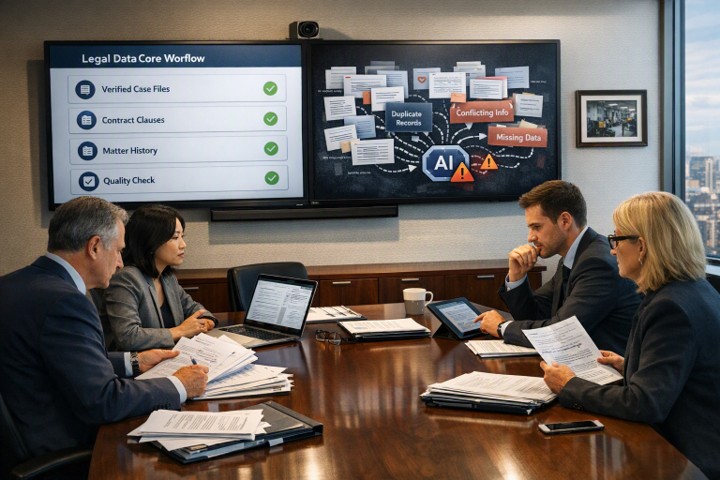
At a Minds Behind the Machines event inside a commercial EV battery plant in Greer, South Carolina, a manufacturing engineer named Clay Smoke said something that had nothing to do with batteries and everything to do with how a small law firm should think about artificial intelligence.
“The only thing worse than the absence of data is bad data,” he told the room. “You can feed AI confident wrong answers if you haven’t done the correct analysis on your measurement system first.”
Smoke was talking about battery cells. But swap a few nouns and he could have been describing the brief on your desk, the intake summary a new tool just generated, or the practice-area page an AI wrote for your website last week. The lesson the manufacturing world learned the hard way is one the legal profession is now learning in real time: a tool is only as trustworthy as the data and the process feeding it. We have written about the sharp end of that problem in The Hallucination Plateau, where AI-fabricated citations are now a standing sanctions risk. This is the upstream version of the same story.
Why a Battery Line and a Law Firm Have the Same AI Problem
In battery manufacturing, a process deviation is not a cosmetic flaw. It can degrade performance, cause a loss of function, or create a genuine safety failure. Smoke put the stakes in plain terms. “A quality slip in automotive manufacturing leads to a quality escape,” he said. “But in battery manufacturing, the consequences have a much higher order of magnitude.”
A law firm operates under the same asymmetry. A typo in a marketing email is a quality escape. A fabricated citation in a filing, a conflict check an AI tool quietly mishandles, or a client-intake message that promises something the firm cannot deliver — those are a much higher order of magnitude. The output of an AI tool always looks finished, and that polish is exactly the problem. A draft that reads cleanly invites a skim instead of a check.
The point is not that AI is dangerous. The point is that confidence is not accuracy, and an AI tool will hand you a confident wrong answer with the same fluency it hands you a correct one.
The Plant Builds Quality Gates. Your Firm Should Too.
Smoke described how the facility manages risk: a layered approach of interlocked equipment systems and electrical testing, with each step acting as a process gate before any product leaves the building. Nothing advances until it clears the gate. Quality is not something an inspector remembers to check at the end. It is built into the workflow.
That structural discipline is exactly what the bar now expects of lawyers. In Formal Opinion 512, issued in July 2024, the American Bar Association made clear that the duty of competence under Model Rule 1.1 requires lawyers to understand the limits of the generative AI tools they use and to independently verify the output. Uncritical reliance on AI can itself be a competence violation.
Most AI problems at law firms are not caused by the tool itself. They come from adding the tool to an old workflow without adding a new checkpoint. The drafting got faster. The review stayed the same, or quietly disappeared.
A defensible process looks like a factory gate, not a reminder. Treat every AI-assisted document as unfinished until it passes a check: sources confirmed against the original, quotes matched to their source, and review handled by someone other than the drafter. Schedule that check as its own task, not a scramble at the deadline. Good intentions are not a quality gate. A process is.
Move From Reactive to Proactive — Before the Filing, Not After
Smoke’s larger argument was about where data actually earns its keep. Connected systems, he explained, let engineers spot “parameter drift” before it turns into a performance problem — moving a plant from reactive problem-solving toward proactive process management. Catch the trend early, and you fix a setting. Catch it late, and you scrap a batch.
For a law firm, proactive means catching the hallucinated case, the wrong jurisdiction, or the stale statute at the draft stage — not after opposing counsel flags it or a judge writes it into an opinion. Catching an AI error early costs a few minutes. Catching it late costs a public sanction and a reputation problem that outlasts the case. The fine can be paid. The damage to a firm’s name is harder to undo, and repairing it becomes a public relations problem long after the docket has moved on.
The same logic applies to client-facing AI. Before you put a chatbot or an AI receptionist in front of prospective clients, you need to know what it will say when nobody is watching. We walked through the questions worth asking first in Should Your Law Firm Build an AI Twin?. Proactive review is cheaper than a retraction.
Flexibility Is a Feature, Not a Liability
One more thing Smoke said is worth borrowing. Rather than building fully dedicated production lines around a single product, the plant deliberately designed for adaptability — changeable tooling, programmable controls, adjustable fixtures — because the underlying technology is still evolving fast.
The same caution applies to your AI stack. The tool you standardize on this year may be eclipsed next year. Do not hard-wire your entire intake, drafting, or client-communication process around one vendor you cannot swap. Build a process that owns the standard, and let the tools plug into it. When the better tool arrives — and in this market, it will — you want to change the tool without rebuilding the firm.
The Bottom Line
AI is only as good as the data and the process behind it. A small firm does not need to fear the technology — it needs to build the same kind of quality gates a battery plant builds: a verification step owned by a second person, a discipline of catching errors at the draft stage rather than the filing stage, and an AI stack flexible enough to swap when something better comes along. The speed AI offers is real, and it only pays off when the checkpoints keep pace.
A factory engineer in Greer arrived at a conclusion about batteries that any practicing attorney would recognize: the discipline of the process matters more than the power of the tool. It travels surprisingly well to a law office.
The same “garbage in, garbage out” rule now governs how your firm shows up in search. Google’s own people-first content guidance rewards original, well-sourced, demonstrably expert content and demotes thin material mass-produced to game rankings — which means an AI-generated practice-area page with no verification behind it is both an ethics risk and a ranking risk. If your firm wants help building a content and communication process that holds up to client scrutiny, the bar’s expectations, and that E-E-A-T standard, Toppe Consulting’s law firm content writing, SEO, website development, and public relations practices work with attorneys across South Carolina.
Sources
This article draws on the following sources.
Smoke, Clay. Remarks delivered as Manufacturing Engineering Manager at a Minds Behind the Machines event, commercial EV battery facility, Greer, South Carolina. Primary source for the quotations on data quality, quality gates, proactive process management, and design flexibility.
American Bar Association, Standing Committee on Ethics and Professional Responsibility. “Formal Opinion 512: Generative Artificial Intelligence Tools,” July 29, 2024. Cited for the duty of competence (Model Rule 1.1) and the requirement to independently verify AI output.
Google Search Central. “Creating Helpful, Reliable, People-First Content.” developers.google.com. Cited for Google’s E-E-A-T framework and its treatment of automated and AI-generated content.
Disclaimer
Toppe Consulting is a digital marketing and public relations agency serving law firms and other legal service providers. We are not a law firm. Nothing in this article constitutes legal advice, and reading it does not create an attorney-client relationship. The information here is provided for general educational and informational purposes only and reflects our perspective as marketing and communications professionals working in the legal services industry. For guidance on the use of artificial intelligence in legal practice, professional responsibility, or court filings, consult a licensed attorney in your jurisdiction or your state bar association.
About the Author
Jim Toppe is the founder of Toppe Consulting, a digital marketing agency working exclusively with solo practitioners and small law firms. He holds a Master of Science in Management from Clemson University, teaches Business Law and Marketing at Greenville Technical College, and is the publisher of South Carolina Manufacturing, a digital magazine.
Related Articles
Recent Industry News
Need Content Written by a Human? Meet Joe Toppe

Your Next Client Is Already Searching. Educational Content Is How They Find You.

Greenville’s Bar Is 126 Years Old. Charleston’s Was Already 201 When It Opened

AALS Convenes National Task Force as the Rules for Becoming a Lawyer Come Apart