
Civil Legal Aid Faces a Second Straight Year on the Budget Chopping Block
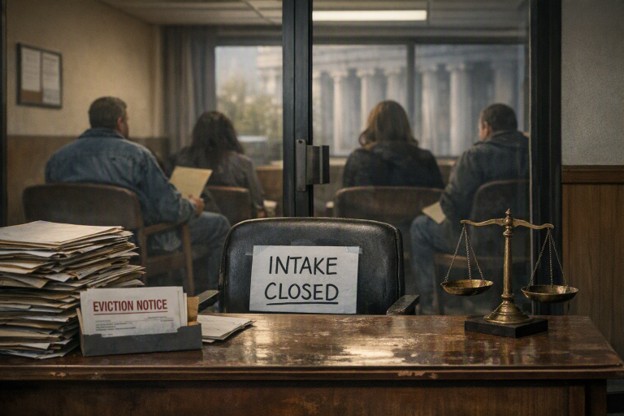
Federal funding for civil legal aid is back in play less than a year after the current budget became law — and the figure a House subcommittee approved this spring would, by the Legal Services Corporation’s account, be its lowest appropriation since 1983.
What Happened
- January 23, 2026: Congress funded the Legal Services Corporation at $540 million for FY 2026 as part of the Commerce, Justice, Science appropriations package, which received broad bipartisan support. That was a 3.6% reduction from the $560 million LSC received in FY 2024 and FY 2025.
- April 3, 2026: The White House FY 2027 budget recommended LSC stop issuing grants for civil legal services, with $21 million allocated for close-out costs. LSC had requested $2.14 billion.
- April 30, 2026: The House CJS Subcommittee approved a bill providing $268 million for LSC — a $272 million reduction of more than 50%.
- May 13, 2026: The full House Appropriations Committee approved the FY 2027 CJS bill by a vote of 32 to 28. The bill is H.R. 8845. Seven amendments were adopted at that markup, and the Committee published its bill text and report prior to those adoptions. The $268 million subcommittee figure is the last publicly confirmed LSC amount.
- June 11, 2026: A bipartisan coalition of 40 state attorneys general urged Congress to continue funding LSC in the FY 2027 CJS bill.
As of late September 2026, we have found no publicly reported Senate Appropriations action on FY 2027 CJS, and no floor vote has occurred in either chamber. The new fiscal year begins October 1, 2026. Everything below describes proposals at a mid-stage of a process that did not conclude until January last cycle.
Why $268 Million Matters
According to LSC, $268 million would be the organization’s lowest appropriation since 1983. LSC states that the 1983 appropriation of $241 million would be worth roughly $760 million today when adjusted for inflation.
LSC estimates the reduction would cost more than 2.8 million people access to legal help, including approximately 486,000 children and nearly 108,000 domestic violence survivors. The organization further projects roughly $1.9 billion in lost economic benefits, based on its own analysis of studies finding an average return of about $7 for every dollar invested in civil legal services.
These figures are LSC’s own estimates, published while the organization advocates for its appropriation.
Who Uses These Services
LSC funds 129 independent nonprofit legal aid organizations across all 50 states, the District of Columbia and U.S. territories. LSC reports those grantees assisted 6.4 million people in 2024. Common matters include:
- Domestic violence protective orders
- Eviction and housing conditions
- Veterans’ benefits claims
- Consumer fraud and financial exploitation of seniors
- Disaster recovery
Eligibility runs at or below 125% of federal poverty guidelines — in 2026, $41,250 for a family of four in the contiguous United States, or $19,950 for an individual.
Current Operating Conditions
LSC’s 2022 Justice Gap study found that grantees cannot serve 49% of the eligible people who seek their assistance. LSC grantees have separately reported losing more than $112 million — over 30% — of their non-LSC funding since 2023. Legal aid advocates quoted in The Texas Lawbook have characterized the pattern as “death by a thousand cuts.”
What the Appropriators Say
The Committee describes the FY 2027 CJS bill as right-sizing federal agencies and refocusing programs on their core missions. Its published summary sets a total discretionary allocation of $77.341 billion — a $670 million decrease from the FY 2026 enacted level — with increased funding directed to the Drug Enforcement Administration, the National Weather Service, and the Bureau of Industry and Security, and reductions across other accounts. Subcommittee Chairman Hal Rogers (R-KY) framed the bill around law enforcement support, fentanyl interdiction, and accountability for federal spending. In the prior cycle, Rogers publicly affirmed the value of LSC’s work while stating that the proposed reduction was necessary for fiscal reasons. The nonpartisan Congressional Research Service tracks the bill’s progress in its FY2027 CJS appropriations overview.
What Comes Next
The FY 2026 cycle offers the closest template. The House Appropriations Committee approved $300 million and the Senate Appropriations Committee approved $566 million; the enacted figure was $540 million. Letters urging robust funding came from 40 bipartisan state attorneys general, 37 bipartisan state supreme court chief justices, leaders of 160 law firms, and general counsels of 104 major corporations. The American Bar Association tracks LSC appropriations, and LSC maintains a Funding Impact Calculator on its website.
The Senate mark is the next step to watch.
About Toppe Consulting
Toppe Consulting is a digital marketing agency in South Carolina, working exclusively with solo practitioners and small law firms. Developments like this one move quickly and receive limited mainstream coverage — which is why firms that publish credible, sourced commentary on issues affecting their clients build authority that advertising cannot replicate.
Contact Toppe Consulting to discuss how your firm can turn industry developments into visibility that brings in clients.
Disclaimer
This article is published solely to raise awareness of a developing federal appropriations matter affecting access to civil legal services. It is not legal advice, does not constitute a political endorsement or a position on federal budget policy, and is not a solicitation for legal services. Figures attributed to the Legal Services Corporation represent that organization’s own estimates and projections. Appropriations amounts described are proposals subject to change; information is current as of late September 2026, and readers should consult primary congressional sources for current status.
Works Cited
“Committee Approves FY27 Commerce, Justice, Science, and Related Agencies Appropriations Act.” House Committee on Appropriations, 13 May 2026, appropriations.house.gov. Accessed 3 Aug. 2026.
“Overview of FY2027 Appropriations for Commerce, Justice, Science, and Related Agencies (CJS).” Congressional Research Service, R48929, 23 June 2026, www.congress.gov/crs-product/R48929.
“Attorney General Bonta Urges Congress to Continue Funding Legal Services for Low-Income Americans and Vulnerable Communities.” California Department of Justice, 11 June 2026.
“Fiscal Year 2027 Budget Request.” Legal Services Corporation. Accessed 3 Aug. 2026.
“Legal Aid Feels ‘Death by a Thousand Cuts’ After Latest Funding Loss.” The Texas Lawbook, 29 Jan. 2026. Accessed 3 Aug. 2026.
“Legal Services Corporation: Background and Funding.” Congressional Research Service, Library of Congress, RL34016. Accessed 3 Aug. 2026.
“LSC Says $2 Billion Needed to Address Low-Income Americans’ Unmet Civil Legal Needs.” Legal Services Corporation, 6 Apr. 2026. Accessed 3 Aug. 2026.
“Proposed Cut to LSC Would Erase Legal Assistance for 2.8 Million Americans.” Legal Services Corporation, 30 Apr. 2026. Accessed 3 Aug. 2026.
“Senate Passes $540M for Legal Services in FY 2026.” Legal Services Corporation, 15 Jan. 2026, www.lsc.gov. Accessed 3 Aug. 2026.
“The Justice Gap: The Unmet Civil Legal Needs of Low-Income Americans.” Legal Services Corporation, justicegap.lsc.gov. Accessed 3 Aug. 2026.
About the Author
Jim Toppe is the founder of Toppe Consulting, a digital marketing agency working exclusively with solo practitioners and small law firms. He holds a Master of Science in Management from Clemson University, teaches Business Law and Marketing at Greenville Technical College, and is the publisher of South Carolina Manufacturing, a digital magazine.
Related Articles
Recent Industry News

Need Content Written by a Human? Meet Joe Toppe
Your Next Client Is Already Searching. Educational Content Is How They Find You.

Greenville’s Bar Is 126 Years Old. Charleston’s Was Already 201 When It Opened
AALS Convenes National Task Force as the Rules for Becoming a Lawyer Come Apart