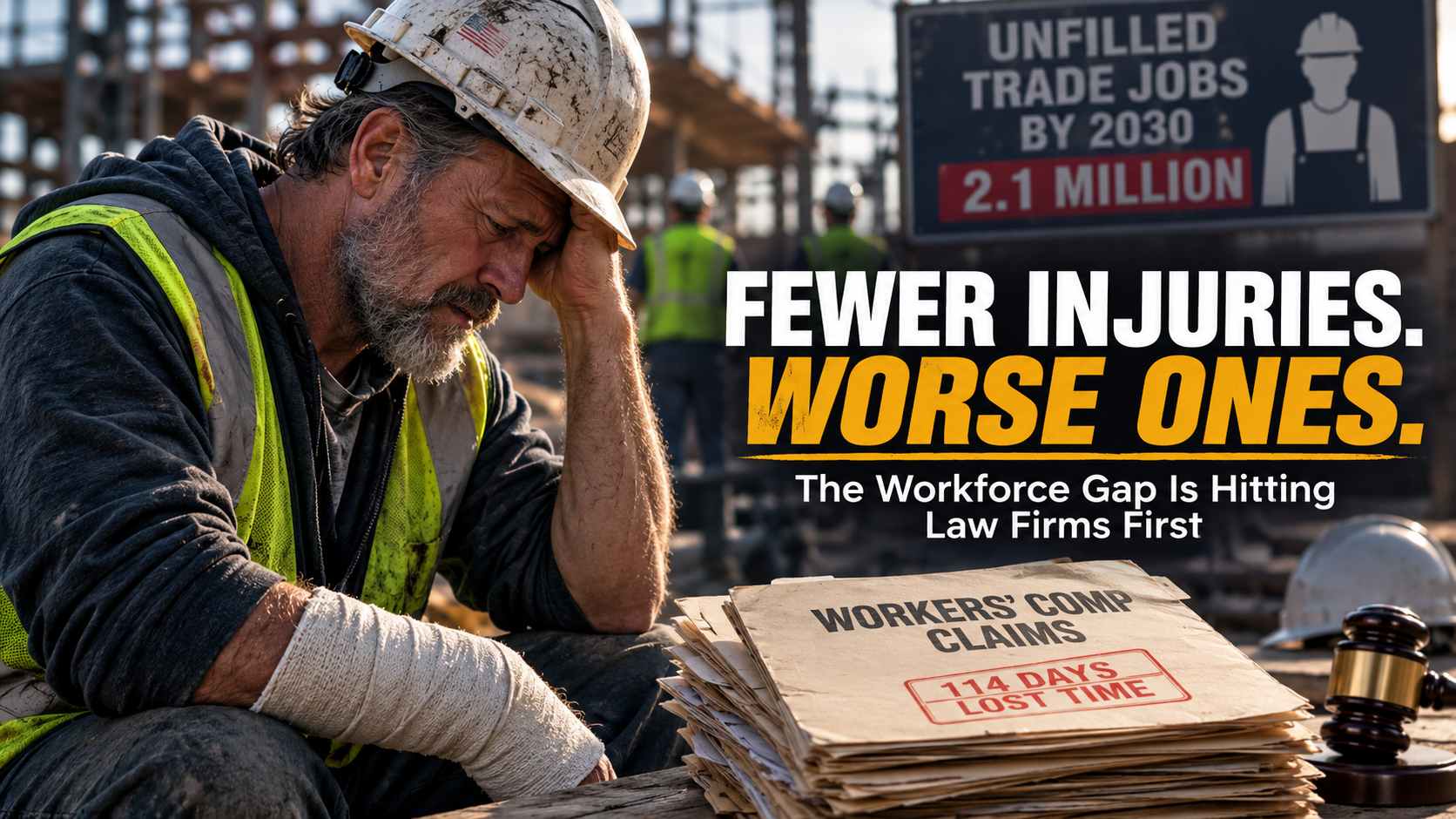
SEO for Worker's Compensation Lawyers
How Do Injured Workers Find Workers Compensation Lawyers Online?
Most injured workers search Google within hours of a denied claim or workplace injury — and workers compensation SEO determines which firm appears at the top. Furthermore, organic rankings deliver the highest-intent prospects every market produces, while paid clicks in workers comp routinely exceed $50 each. Consequently, firms ranking organically conv
Why Workers Comp Firms Cannot Afford Generic Legal SEO
The firm that ranks first always takes the call. Every other firm splits what’s left. Consequently, workers compensation SEO decides which law firm an injured worker finds from a hospital waiting room. Searches include “denied workers comp claim,” “hurt at work lawyer,” and “workplace injury attorney near me.” Additionally, generic legal SEO misses the search behavior, injury-type vocabulary, and local map pack battlegrounds shaping this practice area. Furthermore, firms that invest in workers compensation SEO routinely outrank bigger competitors because relevance beats budget on local queries. Toppe Consulting builds every workers comp campaign around that exact reality, every single day.
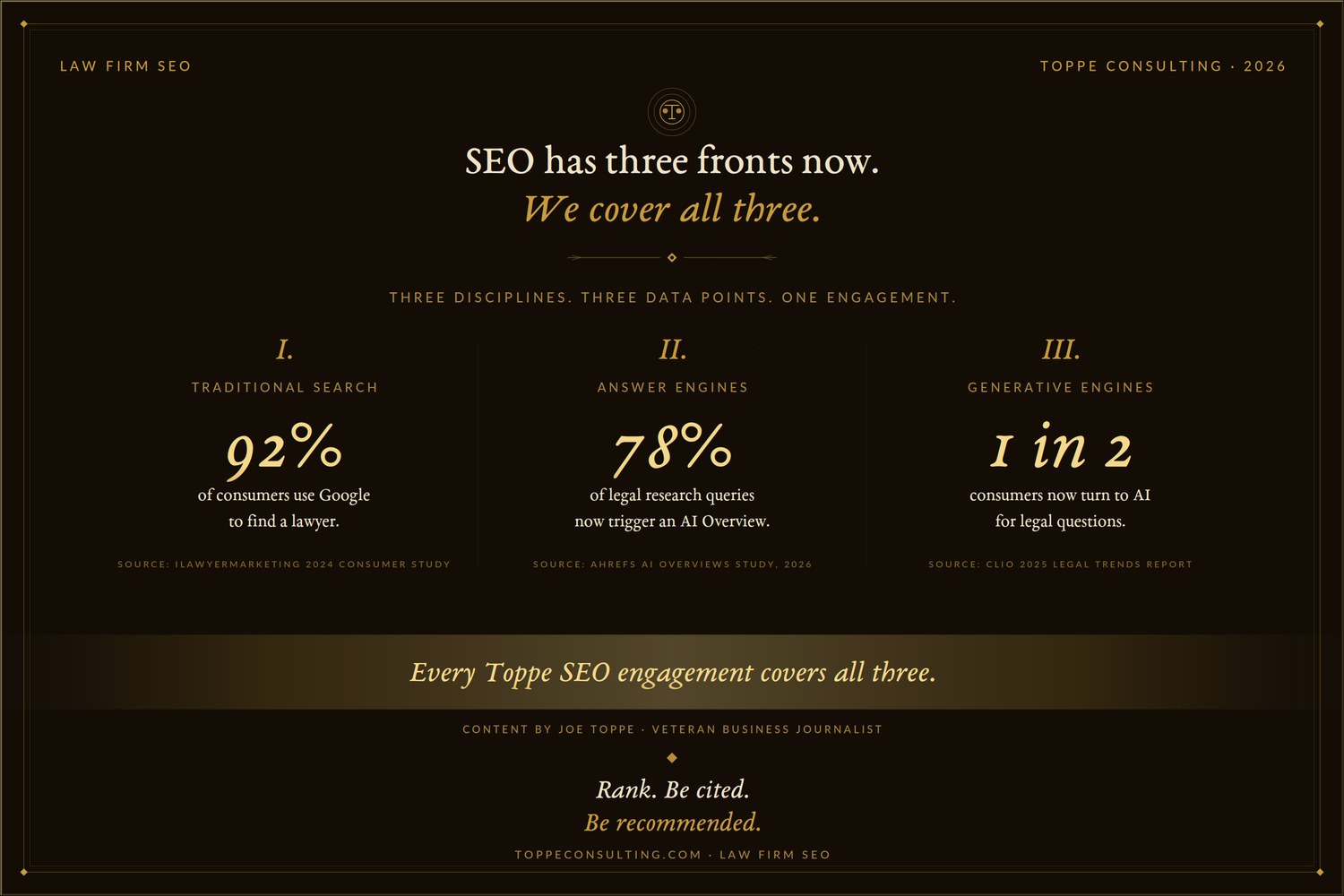
What Workers Compensation SEO Delivers
- Keyword research mapped to injured worker intent — denied claims, employer retaliation, permanent disability, and industry-specific injury searches
- Local SEO optimization that wins map pack rankings for “workers comp lawyer near me” in your exact service cities
- Landing pages built around the denial, appeal, and benefits questions injured workers actually type into Google
- Technical audits that fix speed, crawlability, and mobile experience — because injured workers search from phones
- Authority backlink campaigns earned through press placements and industry-specific editorial outreach
- Monthly reporting that tracks rankings, organic leads, call conversions, and cost-per-signed-case
What Does Workers Compensation SEO Do
Workers compensation SEO does one thing. It puts a law firm in front of injured workers at the moment they search for help. Those searches happen at 2 AM from an ER waiting room. They happen from a parking lot after a claim denial letter arrives. Break room searches come from jobsites where carpal tunnel or back injuries worsen every shift.
The firm that appears first in Google’s organic results and local map pack gets the call. Every other firm loses that case to a competitor. Consequently, the practical mechanics cover keyword research, on-page optimization, local profile management, authority building, and technical performance. We tune each area to how injured workers actually search.
Additionally, strong campaigns include injury-specific content. A warehouse worker searching for rotator cuff settlement advice needs different content than a nurse researching hospital back injuries. Furthermore, both of those searchers need a page that loads fast on mobile, ranks locally, and makes calling easy. Our broader workers compensation digital marketing program coordinates every channel around that outcome — more signed injured-worker cases.
How Do Injured Workers Actually Search for Attorneys?
Injured workers rarely use formal legal terms. They type natural language. Common searches include “hurt at work lawyer,” “denied workers comp claim,” and “workers comp settlement back injury.” Furthermore, roughly two-thirds of all Google searches happen on mobile devices. Many come from hospital waiting rooms, urgent care clinics, or parking lots immediately after an injury.
Why Workers Compensation SEO Matters
The Bureau of Labor Statistics reported 2.5 million nonfatal workplace injuries and illnesses in 2024 — the lowest number in the data series going back to 2003, yet still a staggering pool of potential searchers. Additionally, the American Bar Association’s Legal Technology Survey has consistently found that the overwhelming majority of consumers turn to search engines first when researching an attorney. The top three Google results capture 54.4 percent of all clicks. Consequently, visibility below the fold costs real cases every single day.
Paid advertising delivers immediate traffic. However, organic rankings compound over time and cost dramatically less per lead. SEO leads close at 14.6 percent compared with 1.7 percent for outbound efforts, according to widely cited HubSpot data. Furthermore, consistent organic investment builds compounding authority that paid campaigns cannot replicate once spend stops.
Workers comp searches also skew intensely local. The Google Business Profile map pack decides most cases, not broad national rankings. A firm winning local visibility in its exact service cities captures injured worker searches. Bigger regional competitors will never see those searches. However, strong SEO requires a fast, crawlable foundation underneath. Our workers compensation website design services build sites engineered specifically for that purpose.
Is General Legal SEO Enough for a Workers Comp Practice?
No. General legal SEO targets broad keywords like “lawyer near me” that deliver scattered, lower-intent leads. Workers comp practices need content mapped to denial appeals, industry-specific injuries, and state-specific administrative processes. Additionally, bar advertising rules govern injury practices. Most general SEO agencies have never drafted compliance language and do not know they need to.
How Workers Compensation SEO Works
Every campaign starts with deep keyword research around injured worker search behavior. That means mapping how clients phrase denial appeals, state-specific board processes, settlement questions, and industry-specific injury queries. Moreover, research also covers competitor gaps — finding the keywords bigger firms in your market have overlooked.
On-page optimization follows. We tune every practice area page, every blog post, and every location page around specific search intent. Title tags, meta descriptions, headers, internal linking, and schema markup all work together to signal relevance. Additionally, content addresses real questions injured workers ask — benefits, timelines, appeal procedures, and employer retaliation.
Local SEO then extends those signals into Google Business Profile, local directories, and map pack rankings. Most workers comp firms win or lose at the map pack. Technical performance runs underneath all of it — mobile speed, core web vitals, crawlability, and secure hosting. Finally, authority building through backlinks and press coverage compounds rankings over time. These principles apply across the full discipline of law firm SEO. Our team calibrates every campaign specifically for workers comp.
Why Does Local Map Pack Visibility Matter So Much?
Most injured workers search for attorneys near their home or jobsite. Google responds with a local pack of three firms above traditional results. Consequently, firms appearing in that pack receive the majority of clicks, calls, and consultations. Moreover, pack rankings depend on Google Business Profile optimization, review velocity, citation consistency, and local backlink authority. Generic SEO often neglects those factors.
Industry Verticals That Drive Workers Comp Cases
Three industries generate the bulk of workers compensation case volume — construction, manufacturing, and healthcare. Each brings distinct injury patterns, different search language, and its own legal considerations. Consequently, a page built for “construction site fall injury” converts differently than one targeting “factory repetitive motion injury.” Landing pages for “nurse back injury lawsuit” require a third approach entirely.
Construction cases involve falls, crush injuries, equipment accidents, and scaffolding collapses. Manufacturing cases skew toward repetitive motion, machine-related injuries, chemical exposure, and long-term musculoskeletal damage. Healthcare cases center on back injuries, needlestick exposure, patient-handling injuries, and assault on staff. Additionally, each vertical intersects with different insurance adjusters, employer behavior patterns, and settlement ranges.
AI-driven search has added another layer. ChatGPT, Perplexity, and Google AI now surface legal answers directly. Those answers often cite only a handful of law firms per query. Furthermore, AI Overviews appeared in more than 60 percent of U.S. Google searches as of late 2025, up from roughly 6 percent in January 2025 — with law and government queries among the fastest-growing categories. Our workers compensation AEO services earn citations across those answer engines. Meanwhile, workers compensation GEO extends that authority into generative engines for compounding visibility.
Does Workers Comp SEO Work for Smaller Firms?
Yes. Smaller workers comp firms outrank bigger regional competitors in specific service cities because local relevance beats domain authority. Additionally, a focused practice signals deeper expertise to Google than a generalist firm handling ten practice areas. Furthermore, smaller firms respond to leads faster — and response speed is a documented ranking and conversion factor simultaneously.
Choosing the Right Workers Compensation SEO Partner
Most legal SEO agencies assign workers comp clients to account managers with no real newsroom experience. Those managers have never reported on a workplace injury story or interviewed a claims adjuster. Consequently, the content they produce reads like every other generic legal SEO blog post on the internet. Google notices. Moreover, AI platforms that now drive citation visibility notice even more aggressively.
Toppe Consulting operates differently. Our Content Director, Joe Toppe, is a working journalist. He currently serves as Managing Editor at PropertyCasualty360 — a leading trade publication covering insurance, claims, and workers compensation. Additionally, Joe spent years as Associate Producer and Writer at Fox Business Network in New York. He later served as Senior Business Journalist at Capital.com and Managing Editor at Innovation & Tech Today. Joe’s byline has appeared in Yahoo Finance, the New York Post, and Sky News Australia. He holds a Master’s Degree in Journalism and Mass Communication from Kent State University.
That matters for workers comp SEO directly. Joe reports on claims, insurance, and workplace injury stories every week for his day job. Consequently, his editorial instincts, source network, and claims-ecosystem knowledge shape every piece of content we produce. Workers comp firms receive the direct benefit. Furthermore, press coverage earned through his relationships compounds SEO authority over time. Our workers compensation public relations practice leverages those credentials to earn placements that bigger, journalist-free agencies simply cannot replicate.
Frequently Asked Questions About Workers Compensation SEO
How long does it take for workers compensation SEO to produce results?
Most workers comp firms see measurable ranking improvements within 90 to 120 days. Additionally, lead volume from organic search typically scales by month six. Furthermore, significant map pack dominance in a local market often requires 9 to 12 months. That includes consistent optimization, citation building, and review generation. Results compound every month afterward.
Do you target specific injury types within workers comp?
Yes. Every campaign includes pages built around specific injury categories. Those include back injuries, repetitive stress, construction falls, machine accidents, chemical exposure, and permanent disability claims. Additionally, we target specific denial scenarios and appeal processes. Furthermore, industry-specific pages covering construction, manufacturing, and healthcare workers consistently capture the highest-intent search traffic in most markets.
How does this work with Google Ads or paid search?
SEO and Google Ads complement each other. Paid ads deliver immediate leads while organic rankings develop over the first few months. Moreover, search terms that convert well in ads inform SEO content priorities directly. Consequently, most workers comp firms run both channels — paid for immediate volume, SEO for long-term compounding returns.
Is workers compensation SEO affected by AI search?
Yes, significantly. ChatGPT, Perplexity, and Google AI Mode now surface legal answers directly. Consequently, firms cited as sources in those answers capture visibility that traditional SEO alone no longer reaches. Furthermore, answer engines prioritize content with strong editorial quality, verifiable expertise, and third-party media references. That is why AEO and GEO increasingly matter for workers comp.
What makes Toppe Consulting different for workers comp firms?
Our Content Director, Joe Toppe, runs day-to-day operations as Managing Editor at PropertyCasualty360. The publication leads coverage of insurance, claims, and workers compensation. Consequently, a working journalist whose daily beat covers this industry shapes every piece of content we produce. Furthermore, his newsroom relationships earn press coverage that compounds organic authority over time.
Workers Compensation SEO Is a Compounding Asset
Every month of consistent optimization adds rankings, leads, and authority that do not disappear when a campaign ends. Consequently, firms that invest early outrank competitors who hesitated for years. The question is never whether workers comp SEO works — it is how soon you start.
Recent Industry News

Need Content Written by a Human? Meet Joe Toppe

Your Next Client Is Already Searching. Educational Content Is How They Find You.

Greenville’s Bar Is 126 Years Old. Charleston’s Was Already 201 When It Opened

AALS Convenes National Task Force as the Rules for Becoming a Lawyer Come Apart