
Low-Cost Marketing for Lawyers: Where a Solo Practice Should Spend First
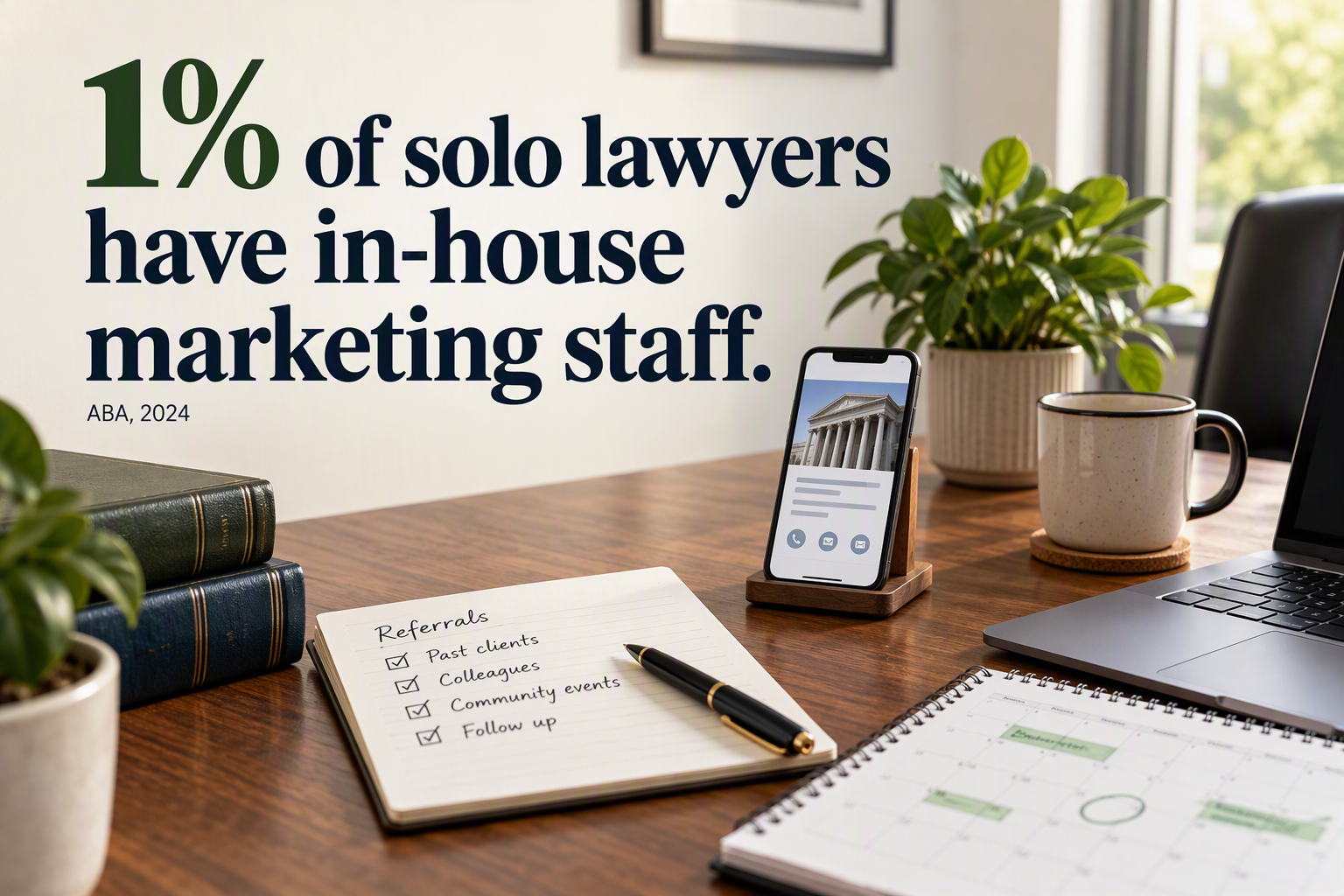
Low-cost marketing for lawyers starts with a fact about who does the work. In the American Bar Association’s 2024 Legal Technology Survey, 1 percent of solo respondents reported having internal marketing staff, compared with 90 percent of respondents from firms of 100 or more attorneys, according to the ABA’s 2024 Practice Management TechReport. Seventy percent of solo respondents reported having a website, up from 61 percent in 2022.
For a solo practice without marketing staff, marketing comes out of the lawyer’s own time. That points to an order of operations: protect the channels that cost the least before buying attention. Spending decisions belong in a written law firm marketing plan, and the order below is a starting point for one.
What Is the Lowest-Cost Marketing a Solo Lawyer Can Do?
The lowest-cost marketing for a solo lawyer is usually time rather than money: keeping in touch with referral sources, claiming and completing a Google Business Profile, asking satisfied clients for reviews where state bar rules permit, and publishing useful answers to common client questions on the firm’s own website.
Step 1 — Treat Referrals as a System
Referrals come from past clients, other lawyers, and professionals such as accountants and financial advisers. A referral network costs little to maintain, but it needs a list and a calendar. Keep a record of who has sent matters, follow up with a thank-you note, and stay in touch through the year.
Know the limit before setting anything up. ABA Model Rule 7.2 generally bars giving anything of value in exchange for a recommendation, with narrow exceptions such as nominal thank-you gifts that were not promised in advance. Confirm your state’s version of the rule first.
Step 2 — Complete the Google Business Profile
According to Google Business Profile Help, local results are based mainly on relevance, distance, and prominence, and businesses with complete and accurate information are more likely to appear in local search results. Google also states that there is no way to request or pay for a better local ranking.
For a law firm, a complete profile means the correct firm name, address, phone number, hours, primary category, and a description of practice areas. Google notes that more reviews and positive ratings can help a business’s local ranking. Review requests and replies are communications about the firm’s services, so state advertising and confidentiality rules apply to both.
Is a Google Business Profile Worth It for a Solo Law Firm?
A Google Business Profile is worth completing for most solo law firms that serve local clients, because Google draws local results from profile information and says complete, accurate profiles are more likely to appear. The main cost is the owner’s time to verify the listing, fill in every field, and keep hours and contact details current.
Step 3 — Publish Answers to the Questions Clients Already Ask
A firm’s own website is the one channel it fully controls. A short post answering a question the phone keeps ringing about costs writing and review time rather than ad spend. Our guide to law firm blog rules covers what can and cannot go into those posts.
Step 4 — Add Paid Channels After the Foundation Works
Paid search and directory listings can make sense once referrals are organized, the profile is complete, and the website turns visits into calls. Before that point, paid traffic lands on the same gaps. Record where each consultation came from for a few months first, so any paid channel has a baseline to be measured against.
A Schedule, Not a Budget
None of these first steps depends on a large budget. Each depends on a schedule and on someone accountable for keeping it.
Toppe Consulting: Digital Marketing for Small Law Firms
Toppe Consulting works exclusively with solo practitioners and small law firms. Content is written in-house by Joe Toppe, a Managing Editor at PropertyCasualty360 and former Fox Business Network writer. No long-term contracts, and a clear quote upfront.
Our Services Include:
- New Law Firm Website Design — Websites for attorneys opening or relaunching a practice
- Law Firm SEO — Practice area pages and content built around how clients actually search
Starting from scratch or starting over?
Contact Toppe Consulting for a quote with no contract attached.
About the Author
Jim Toppe is a co-founder of Toppe Consulting, a digital marketing agency that works exclusively with law firms. He has 10 years of experience in digital marketing for law firms, holds a Master of Science in Management from Clemson University, and teaches Business Law and Marketing at Greenville Technical College. Jim is also the publisher of South Carolina Manufacturing, a digital magazine. He brings his background in business law and marketing to websites, content, and search strategies built with attorney advertising rules in mind.
Works Cited
Google. “How to Improve Your Local Ranking on Google.” Google Business Profile Help, support.google.com/business/answer/7091?hl=en. Accessed 3 Oct. 2026.
Klevan, Alan. “2024 Practice Management TechReport.” ABA TechReport 2024, American Bar Association Law Practice Division, www.americanbar.org/groups/law_practice/resources/tech-report/2024/2024-practice-management-techreport. Accessed 3 Oct. 2026.
Toppe Consulting provides digital marketing services to law firms. This website does not offer legal advice.
Bar advertising rules vary by state and change over time. Confirm current requirements with your state bar.
Related Articles
- How to Build a Law Firm Marketing Plan: A 2026 Guide for Solo and Small Practices
- Law Firm Website Checklist: The Features Every Attorney Site Needs in 2026
- Law Firm Blog Rules: What Makes Attorney Content Worth Reading and Safe to Publish
- Law Firm Website Updates: How Often, What to Check, and Why Accessibility Matters
Recent Industry News

Need Content Written by a Human? Meet Joe Toppe

Your Next Client Is Already Searching. Educational Content Is How They Find You.

Greenville’s Bar Is 126 Years Old. Charleston’s Was Already 201 When It Opened

AALS Convenes National Task Force as the Rules for Becoming a Lawyer Come Apart