
How Often, What to Check, and Why Accessibility Matters
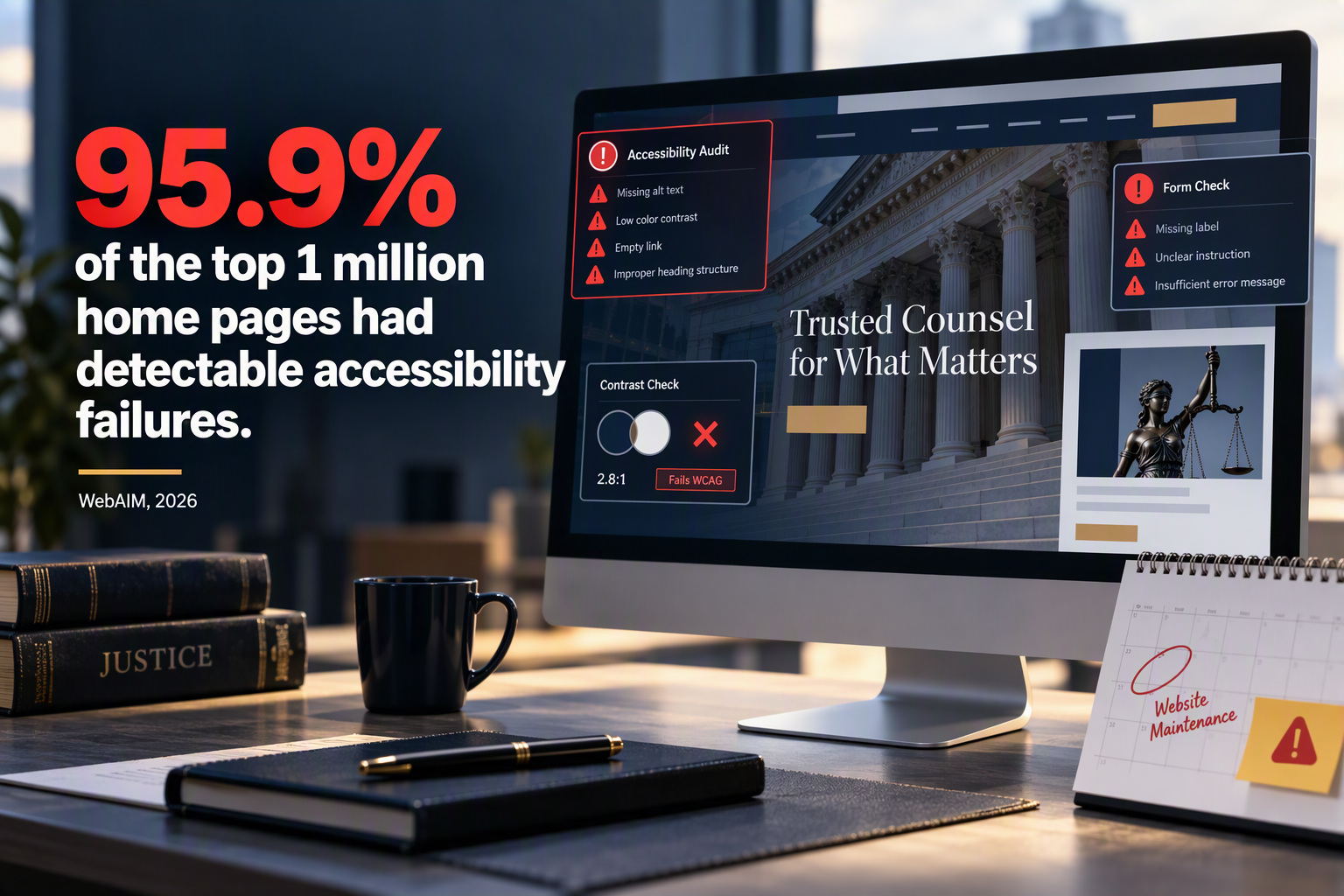
Law firm website updates often happen in bursts: a redesign, then years of drift. The drift is where problems collect. In February 2026, WebAIM tested the home pages of one million of the web’s most-visited sites and found detectable WCAG 2 accessibility failures on 95.9 percent of them, up from 94.8 percent in 2025, according to The WebAIM Million 2026 report.
WordPress home pages in that sample, 252,302 of them, averaged 52.8 detected errors each. Home pages WebAIM grouped under law, government, and politics averaged 46.6. Keeping a site current is one line item in a law firm marketing plan, and it is easy to postpone because nothing visibly breaks.
What Accessibility Errors Should a Law Firm Check For First?
WebAIM’s 2026 analysis found six error types account for 96 percent of detected failures: low-contrast text, missing image alt text, unlabeled form fields, empty links, empty buttons, and a missing page language setting. A law firm can check its own site for all six during routine website updates.
Why Accessibility Belongs on the Update Schedule
The U.S. Department of Justice’s Guidance on Web Accessibility and the ADA, published March 18, 2022, states the department’s position that the ADA’s requirements apply to the goods and services that businesses open to the public offer on the web. The guidance points to the Web Content Accessibility Guidelines as a helpful technical standard. It also states that it has no legally binding effect, so how it bears on a particular firm is a question for that firm’s own legal judgment.
The guidance warns that automated checkers and overlays need careful use. A clean automated report does not by itself mean a site is accessible, and DOJ suggests pairing automated tools with a manual check. WebAIM makes the same point about its own data: the absence of detected errors does not show that a page is accessible. DOJ also recommends giving visitors a way to report accessibility problems.
A Practical Update Schedule
Monthly. Apply WordPress core, theme, and plugin updates, which is how known security fixes reach the site. Then test the contact form and tap-to-call links. WebAIM links rising error counts to growing page complexity, so check each new plugin or widget for the six common errors.
Quarterly. Review attorney bios, practice area pages, office hours, and fees language for anything out of date. Run an automated accessibility check and fix what it finds.
Once a year. Complete a manual accessibility review, including keyboard-only navigation and a screen reader pass on the home page, contact page, and most-visited practice area pages. Confirm the site offers a way for visitors to report accessibility problems.
How Often Should a Law Firm Update Its Website?
A law firm should apply software and security updates monthly, review content and run an automated accessibility check quarterly, and complete a manual accessibility review once a year. Any change in attorneys, phone numbers, office locations, fees language, or practice areas should go live the same week it happens.
Updates Keep the Standard in Place
A schedule keeps a site in shape. Our law firm website checklist defines what that shape should be before the first round of updates begins.
Toppe Consulting: Digital Marketing for Small Law Firms
Toppe Consulting works exclusively with solo practitioners and small law firms. Content is written in-house by Joe Toppe, a Managing Editor at PropertyCasualty360 and former Fox Business Network writer. No long-term contracts, and a clear quote upfront.
Our Services Include:
- Law Firm Website Maintenance — Website maintenance, updates, and security patching
- Law Firm Website Design — Custom sites with content written by working journalists
Starting from scratch or starting over?
Contact Toppe Consulting for a quote with no contract attached.
About the Author
Jim Toppe is a co-founder of Toppe Consulting, a digital marketing agency that works exclusively with law firms. He has 10 years of experience in digital marketing for law firms, holds a Master of Science in Management from Clemson University, and teaches Business Law and Marketing at Greenville Technical College. Jim is also the publisher of South Carolina Manufacturing, a digital magazine. He brings his background in business law and marketing to websites, content, and search strategies built with attorney advertising rules in mind.
Works Cited
U.S. Department of Justice, Civil Rights Division. “Guidance on Web Accessibility and the ADA.” ADA.gov, 18 Mar. 2022, www.ada.gov/resources/web-guidance/.
WebAIM. “The WebAIM Million: The 2026 Report on the Accessibility of the Top 1,000,000 Home Pages.” WebAIM, Utah State University, 30 Mar. 2026, webaim.org/projects/million/.
Toppe Consulting provides digital marketing services to law firms. This website does not offer legal advice.
Related Articles
- How to Build a Law Firm Marketing Plan: A 2026 Guide for Solo and Small Practices
- Law Firm Website Checklist: The Features Every Attorney Site Needs in 2026
- Law Firm Blog Rules: What Makes Attorney Content Worth Reading and Safe to Publish
- Low-Cost Marketing for Lawyers: Where a Solo Practice Should Spend First
Recent Industry News

Need Content Written by a Human? Meet Joe Toppe

Your Next Client Is Already Searching. Educational Content Is How They Find You.

Greenville’s Bar Is 126 Years Old. Charleston’s Was Already 201 When It Opened

AALS Convenes National Task Force as the Rules for Becoming a Lawyer Come Apart