The $1 Trillion Skills Gap: How AI Automation Is Widening Manufacturing’s Workforce Crisis

Toppe Consulting – Your Source for Digital News & Trends in the Legal Industry
American manufacturing is accelerating toward automation faster than its workforce can adapt — and that gap is producing a surge in workplace accidents, OSHA violations, and injured workers who need legal representation. The same $1 trillion skills crisis crushing manufacturers is creating significant caseload opportunities for personal injury and workers’ compensation attorneys serving Greenville’s industrial sector.
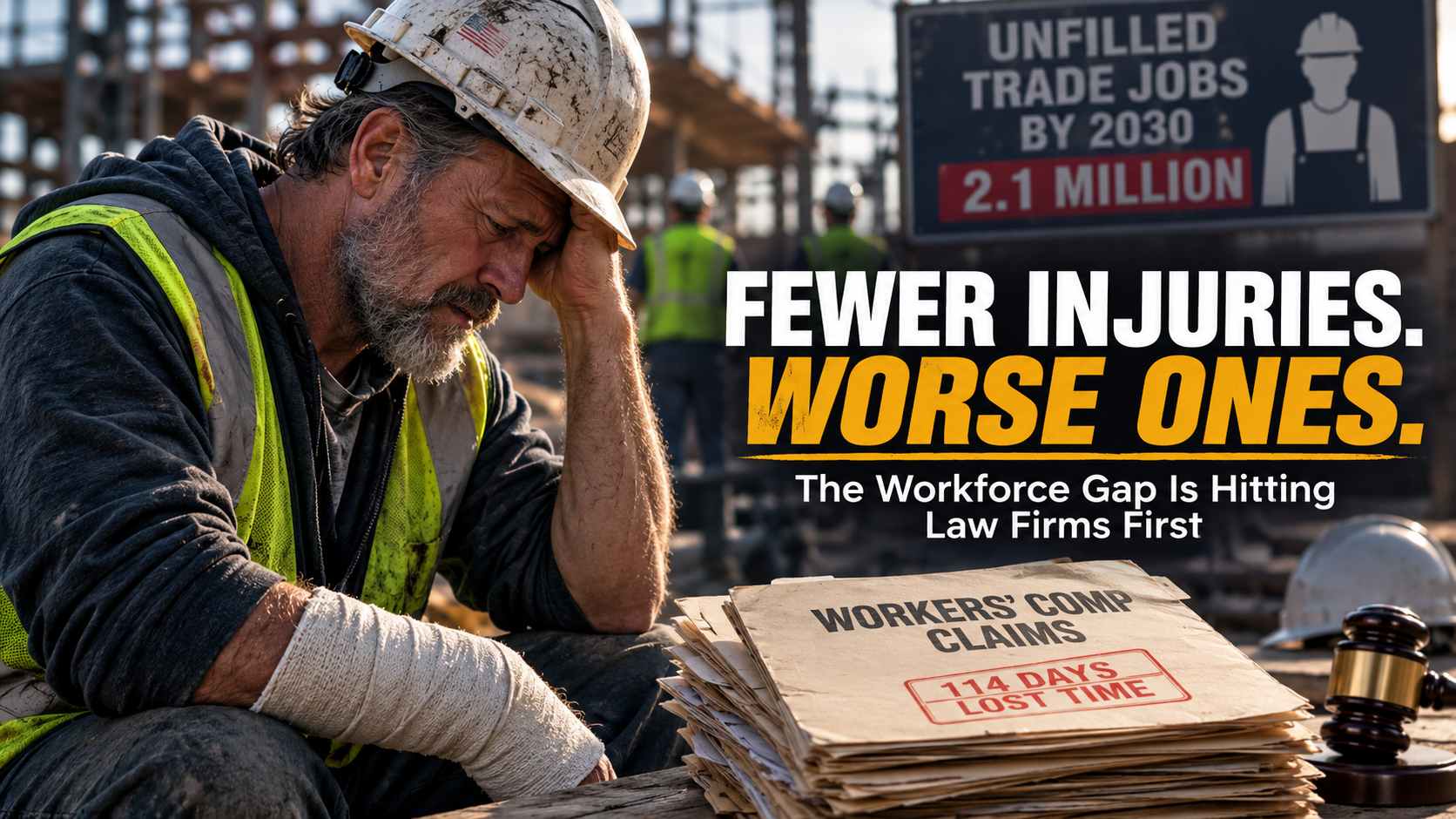
The numbers tell the story directly. Deloitte and The Manufacturing Institute project 2.1 million unfilled manufacturing jobs by 2030. Meanwhile, 94% of manufacturing executives acknowledge a critical skills gap in their current workforce. Undertrained workers operating equipment they don’t fully understand are the conditions that produce the cases personal injury attorneys handle every day.
The machinery is getting more complex. The workers operating it are less experienced. The training programs haven’t caught up. That combination is a workplace accident waiting to happen — and in Greenville’s industrial corridor, it is already happening.
Why Rushed Automation Creates More Workplace Injuries
According to Microsoft’s 2025 Manufacturing Signals Report, 80% of manufacturers are adopting or planning to adopt generative AI. The equipment being deployed requires workers who can program industrial robots, troubleshoot AI-driven quality control systems, and maintain increasingly complex automated production lines. Most workers on those floors today were never trained for any of it.
Manufacturers report taking more than 90 days to recruit highly skilled workers. Rather than wait, many are assigning undertrained employees to operate equipment beyond their competency. The National Institute of Standards and Technology notes that as labor shortages persist, manufacturers are turning to automation to boost efficiency — accelerating the cycle where technology adoption outpaces workforce preparation.
The result is predictable. Workers unfamiliar with automated systems make mistakes that result in crush injuries, amputations, burns, and fatalities. OSHA violations accumulate on factory floors where supervisors don’t know what proper compliance looks like for equipment that didn’t exist five years ago.
The Retiring Workforce Problem and What It Means for Liability
The 2.7 million baby boomers expected to retire from manufacturing by 2025 possessed deep expertise in mechanical systems, traditional machining, and hands-on safety protocols developed over decades. That institutional knowledge is leaving the workforce faster than companies can document or transfer it.
Younger replacement workers lack the experience to recognize unsafe conditions, identify equipment malfunctions before they become accidents, or push back against supervisors cutting corners on safety. Employers who place inexperienced workers on complex automated equipment without adequate training are creating exactly the negligence that personal injury attorneys need to establish liability.
Training Costs Employers Are Choosing Not to Pay
Effective upskilling requires significant time investment — workers need hundreds of hours to gain competency in industrial robotics or predictive maintenance systems. Companies report that recruiting and training costs for skilled workers can exceed $40,000 per employee. Manufacturers operating on thin margins are making the calculation that training costs more than the risk of an accident.
That calculation creates employer liability. When a manufacturer knowingly places an undertrained worker on dangerous equipment to avoid training costs, and that worker is injured, the negligence case writes itself. Personal injury attorneys who understand the manufacturing skills gap can use it to establish that employers knew the risks and chose not to mitigate them.
What This Means for Personal Injury Law Firms in Greenville
Greenville’s manufacturing sector is modernizing rapidly to compete globally. BMW, Michelin, GE, and hundreds of smaller industrial employers are all investing in automation. Each investment that outpaces workforce training is a potential case. Each OSHA violation on a newly automated production line is evidence of employer negligence.
Personal injury law firms with specific knowledge of manufacturing operations, OSHA compliance standards, and industrial equipment liability are positioned to serve this growing caseload. Attorneys who understand how AI and automation create workplace hazards can investigate cases more effectively, identify liable parties beyond the immediate employer, and build stronger damages arguments for injured workers facing long-term disability from injuries that should never have happened.
The skills gap isn’t closing. Automation investment is accelerating. The conditions producing manufacturing workplace injuries in Greenville are getting more concentrated, not less. Personal injury attorneys who position their practices now to serve injured manufacturing workers are entering a market where demand will grow steadily for years.
Industry Standards and Compliance Resources
The Occupational Safety and Health Administration provides comprehensive guidance on workplace safety standards that personal injury attorneys must understand to effectively represent injured manufacturing workers and build strong liability cases involving automated industrial equipment.
The Department of Labor offers detailed information about workers’ compensation systems and coordination with personal injury claims — critical knowledge for attorneys maximizing recovery for injured manufacturing workers across every available coverage source.
Frequently Asked Questions
How does the manufacturing skills gap create personal injury cases?
Manufacturers deploying automation faster than they train workers are placing undertrained employees on dangerous equipment. When those workers are injured, employer negligence is often straightforward to establish — particularly when training records show inadequate preparation for the equipment involved.
What OSHA violations are most common in automated manufacturing facilities?
Lockout/tagout violations, inadequate machine guarding, insufficient hazard communication, and failure to train workers on new equipment are the most frequent OSHA citations in facilities transitioning to automated production. Each citation is potential evidence in a personal injury case.
Can injured manufacturing workers recover beyond workers’ compensation?
Yes. Third-party claims against equipment manufacturers, maintenance contractors, and staffing agencies are common in manufacturing injury cases. Personal injury attorneys with manufacturing expertise identify all potentially liable parties — not just the direct employer — to maximize total recovery.
How does Greenville’s manufacturing growth affect personal injury caseloads?
As Greenville’s industrial sector expands and modernizes, more workers are being placed on complex automated equipment without adequate training. That creates more OSHA violations, more workplace accidents, and more injured workers who need specialized legal representation from attorneys who understand manufacturing operations.
About the Author
Jim Toppe is the founder of Toppe Consulting, a digital marketing agency specializing in law firms. He holds a Master of Science in Management from Clemson University and teaches Business Law and Marketing at Greenville Technical College. Jim also serves as publisher and editor for South Carolina Manufacturing, a digital magazine. His unique background combines legal knowledge with digital marketing expertise to help attorneys grow their practices through compliant, results-driven strategies.
Works Cited
Rao, G. Nagesh, and Jyoti K. Malhotra. “What’s Coming for US Manufacturing in 2025.” National Institute of Standards and Technology, U.S. Department of Commerce, 20 Feb. 2025, www.nist.gov/blogs/manufacturing-innovation-blog/whats-coming-us-manufacturing-2025. Accessed 7 Nov. 2025.
Related Articles
Recent Industry News
Need Content Written by a Human? Meet Joe Toppe

Your Next Client Is Already Searching. Educational Content Is How They Find You.

Greenville’s Bar Is 126 Years Old. Charleston’s Was Already 201 When It Opened
AALS Convenes National Task Force as the Rules for Becoming a Lawyer Come Apart