
Need Content Written by a Human? Meet Joe Toppe
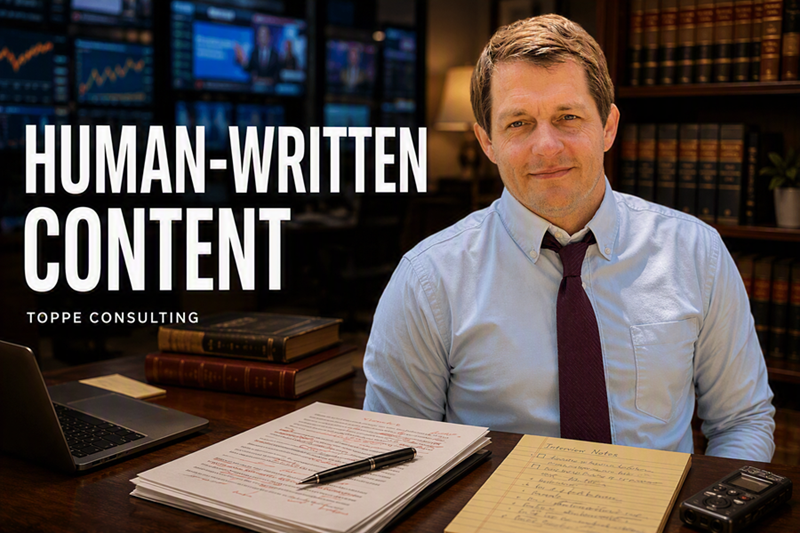
Joe Toppe spent his career in newsrooms. He was an Associate Producer and Writer at Fox Business Network in New York, covering the New York Stock Exchange and global markets. Before Fox Business he reported on international finance as a Senior Business Journalist at Capital.com in London. He served as managing editor at Innovation & Tech Today, a nationally distributed magazine, and as managing editor at PropertyCasualty360, the trade publication covering the U.S. property and casualty insurance market. He holds a master’s degree in journalism from Kent State University.
He is the content director at Toppe Consulting, and what he does now is write for law firms.
Firms use him two ways. Some hand the work over. Toppe Consulting writes it, the firm reviews it, and it publishes under the firm’s name. Other firms have plenty to say and no time to shape it. Joe interviews those attorneys and works with them until the piece is worth publishing.
What Human Writing Does for a Reader
First-hand experience is the one thing a language model cannot supply. It has read about depositions. It has never taken one.
On the page, that experience shows up in small things. A number that came from somewhere. A detail from a courtroom that nobody would have thought to invent. A position the writer had to take a risk to hold.
Generated copy has a texture readers recognize. Fluent, confident, and empty of anything the writer had to earn.
Readers do not run detection software. They form an impression, and the impression is that nobody at the firm had much to say. For a profession whose product is judgment, that impression is expensive.
A different risk sits alongside it. Unverified machine output that reaches a court filing produces a public record, and AI sanctions against lawyers have settled into a steady quarterly volume of rulings.
Does Google Penalize Content Written by AI?
Google does not penalize content for being machine-written. Google Search Central’s guidance, updated 10 December 2025, says generative AI can be useful for researching a topic and for adding structure to original content. What the spam policy targets is producing many pages without adding value for users, a standard that catches a human content farm just as readily.
That is the accurate position, and any reader who checks will find it in one click.
The standard that does separate content sits in Google’s people-first content guidance. It asks site owners whether their content clearly demonstrates “first-hand expertise and a depth of knowledge” of the kind that comes from having actually used a product or service, or visited a place. Google puts trust at the top of its E-E-A-T framework, with experience feeding into it.
Experience is the part a firm can only get from a person who has one.
What Gets a Law Firm Page Cited in AI Search?
ChatGPT, Claude, and Gemini find and cite sources in three different ways, and none of them works quite like Google organic search. A page built only for Google organic misses most of the available surface area. What tends to get pulled is a page that answers one specific question completely, in plain language, with the business clearly identified.
Depth beats frequency in all three. Thin pages get passed over.
The unit these engines extract is small. A bolded answer of roughly 40 to 60 words that still makes sense when it is lifted off the page and read alone. Writing the sub-questions a prospective client actually types matters more than covering the broad topic.
Everyone Has the Tools Now
Clio released Legal Trends for Solo and Small Law Firms on 4 May 2026, drawn from a survey of more than 1,700 respondents. It found that 71% of solo practitioners and 75% of small firms now use AI to complete legal work. Fewer than 33% of solo and small firms have increased revenue with it. Clio reported that most of these firms rely on consumer-grade, general-purpose tools rather than AI built for legal work.
The first number is the one to sit with. The firm across the street has the same capability your firm has. Output is no longer scarce, and publishing more of it competes against everyone else publishing more of it.
The same arithmetic applies to every AI decision a small firm faces now, including whether to build an AI twin.
Working With Toppe Consulting
Toppe Consulting writes blogs, articles, newsletters, case studies, social media, and website copy. The clients are solo practitioners and small law firms. There are no long-term contracts, and the quote comes up front.
Contact Toppe Consulting to talk about what your firm needs written and who is going to write it.
About Toppe Consulting
Toppe Consulting is a digital marketing agency in Salem, South Carolina, founded by Jim Toppe and Joe Toppe. The firm works with solo practitioners and small law firms. Content is written by working journalists, and there are no long-term contracts. Services include law firm content writing and law firm public relations. Contact Toppe Consulting for a quote.
Disclaimer
Toppe Consulting provides digital marketing services to law firms. This website does not offer legal advice.
Works Cited
“Creating Helpful, Reliable, People-First Content.” Google Search Central, Google, 10 Dec. 2025, developers.google.com/search/docs/fundamentals/creating-helpful-content. Accessed 14 Sept. 2026.
“Google Search’s Guidance on Using Generative AI Content on Your Website.” Google Search Central, Google, 10 Dec. 2025, developers.google.com/search/docs/fundamentals/using-gen-ai-content. Accessed 14 Sept. 2026.
Legal Trends for Solo and Small Law Firms. Clio, 2026, www.clio.com/resources/legal-trends/2026-solo-small-firm-report/. Accessed 14 Sept. 2026.
“Report: Small Law Firms Lag Larger Peers on Using AI to Grow Revenue.” Clio, 4 May 2026, www.clio.com/about/press/2026-solo-small-firm-report/. Accessed 14 Sept. 2026.
Related Articles
Recent Industry News

Your Next Client Is Already Searching. Educational Content Is How They Find You.

Greenville’s Bar Is 126 Years Old. Charleston’s Was Already 201 When It Opened

AALS Convenes National Task Force as the Rules for Becoming a Lawyer Come Apart

Five Retire, Two Replace: The Trades Gap Is Quietly Rewriting Injury Caseloads