
Law Firm Website Design Process
Home Services Law Firm Website Development Website Design Process
What Is the Website Design Process?
It is the set of steps that takes a law firm website from first conversation to launch. At Toppe Consulting, the website design process has five steps: discovery, a competitive audit, content creation, design and build, and launch. Each step is reviewed and approved before the next one begins.
Many attorneys who come to us have been through a build that moved fast and asked few questions. The site looked fine, but it said little about the firm and gave visitors little reason to call. A defined process is how we avoid that outcome. Toppe Consulting is a digital marketing agency in South Carolina, working exclusively with solo practitioners and small law firms. We follow the same five steps on every law firm website development project, from a five-page solo site to a custom build for a multi-attorney firm.
What Every Toppe Consulting Website Build Includes
- A discovery session about your practice areas, your market, and your ideal clients
- A review of what other firms in your market publish online, and what they leave out
- Interviews with our content team that shape every page of copy
- Copy reviewed against your state’s advertising rules before design begins
- Custom WordPress design built mobile-first, with SEO, AEO, and GEO set up during the build
- Launch testing, hands-on training, and 30 days of maintenance included
Contact Us Today to Get Started
How the Website Design Process Works, Step by Step
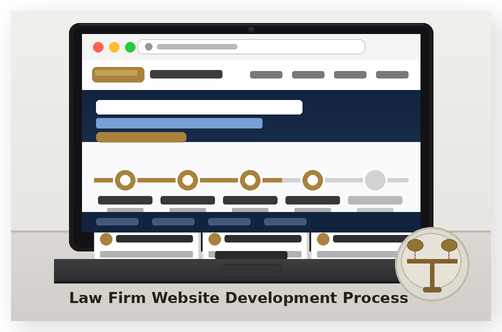 Each step builds on the one before it. Nothing moves forward until you approve it.
Step 1 — Discovery. We start with a focused conversation about your practice areas, your ideal clients, and your local market. We also ask what has not worked for you before. Those answers shape the content plan, the design direction, and how the site is set up for search.
Step 2 — Competitive Audit. Next, we look at what other attorneys in your market publish online. We note the questions they answer, the ones they skip, and how their sites handle a visitor on a phone. Those gaps become part of your content plan.
Step 3 — Content Creation. After the audit, our content team interviews you about your cases, your clients, and the concerns people bring to your office. Joe Toppe leads that work, drawing on a career at Fox Business Network and PropertyCasualty360. Our law firm content writing team turns those interviews into pages written for the prospective client, not for other lawyers. Every page is reviewed against your state’s advertising rules before you see it.
Step 4 — Design and Build. With approved copy in hand, we design the site around it. Every site runs on WordPress, and you own it from day one. We build for phones first, since many people look for a lawyer on mobile. Law firm SEO basics, including title tags, meta descriptions, schema markup, and Google Business Profile alignment, are set up during the build rather than after launch.
Step 5 — Launch and Support. Before launch, we test contact forms, page speed, SSL security, navigation, and internal links across devices. At launch, we walk you through basic updates in WordPress. Every build includes 30 days of law firm website maintenance, and you can keep the plan for $199 per month.
How Long Does the Website Design Process Take?
Many law firm websites launch four to eight weeks after kickoff. The timeline depends mostly on the size of the site and how quickly content and design get approved. Design usually takes one to two weeks. Interviews, writing, revisions, and approvals take the rest. Firms that review drafts quickly tend to launch sooner.
Why the Website Design Process Matters for Law Firms
Law firm websites carry obligations that most business sites do not. Every claim about experience or results falls under your state’s lawyer advertising rules. Visitors often arrive worried, and they decide quickly whether to call or go back to the search results.
A process built around those facts puts the hard decisions first. Discovery informs the content. Content shapes the design. Design and development carry that work into a site that loads quickly, reads clearly, and gives visitors a plain next step.
Skipped steps tend to show up later. A site written from a questionnaire often sounds like every other firm in town, and copy that misses review can create problems with your state bar.
Why Does Content Come Before Design?
Because the words decide what the design needs to hold. When copy comes first, each page is laid out around real practice area content, attorney bios, and calls to action. If design comes first, writers end up filling boxes sized for placeholder text. Writing first also lets compliance review happen before anything is built.
The Website Design Process for Solo and Small Firms
In the American Bar Association’s 2024 survey of lawyers, 70 percent of solo practitioners reported having a website, up from 61 percent in 2022, according to the ABA’s 2024 Websites and Marketing TechReport. Across all respondents, 90 percent reported having one.
That leaves many solo practices still building a first site, and many more replacing one that no longer fits. The same five steps apply either way. Solo attorneys often benefit most from a defined process, because there is no internal team to catch what a rushed build misses. Attorneys opening a new practice can start with our new law firm website design packages, which follow this same process and start at $1,000.
Does the Website Design Process Include Advertising Rule Review?
Yes. Every page of copy is reviewed against your state’s lawyer advertising rules before you see it, and again before launch. Claims about experience, past results, specialization, and comparisons with other firms get extra attention. The review is built into the content and design steps rather than saved for a final pass.
Choosing a Partner With a Real Website Design Process
Many agencies say they have a process. Fewer can walk you through each step, explain why it exists, and show what comes out of it. When you compare partners, look for:
- A written process with defined steps and approvals
- Content built from interviews, not questionnaires or placeholder copy
- Review against your state’s advertising rules during writing, not only before launch
- SEO, AEO, and GEO set up during the build
- WordPress ownership from day one, with no exit fees
- Support after launch, including maintenance and law firm digital marketing
Toppe Consulting works only with law firms. Joe Toppe leads the interview and content steps. He is Managing Editor at PropertyCasualty360 and a former Associate Producer and Writer at Fox Business Network, with a Master’s Degree in Journalism and Mass Communication from Kent State University. Jim Toppe holds a Master of Science in Management from Clemson University and teaches Business Law and Marketing at Greenville Technical College.
Frequently Asked Questions About the Website Design Process
What do I need to provide to get started?
Not much. We need time for a discovery session and interviews, a professional headshot, and basic details about your practice areas and the clients you serve. We write the content, handle the technical decisions, and manage the schedule. Your role is to answer our questions, review drafts, and approve each step.
What if I already have a website I want to redesign?
We start with an audit of your current site to see what is worth keeping and what needs rebuilding. In most cases you keep your domain, and we redirect existing pages to their new addresses. That helps protect the search history your site has already built during the move.
How many revisions are included in the process?
Revision rounds are included at both the content stage and the design stage. Many projects reach approval in one or two rounds, because the interviews give us a clear picture of your firm before writing starts. If something still feels off, we keep working on it with you before moving to the next step.
Is SEO set up before the site launches?
Yes. Title tags, meta descriptions, schema markup, page structure, and Google Business Profile alignment are set up during the build, not after launch. No one can promise where a new site will appear in search, but launching with that groundwork in place gives ongoing SEO work a stronger starting point.
What happens after my site launches?
We walk you through basic WordPress updates so routine changes stay within reach. Every build includes 30 days of maintenance. After that, our maintenance plan is $199 per month and covers updates, backups, security monitoring, and small content changes. Many firms also add SEO or content writing once the site is live.
A Website Design Process Built Around Your Firm
Five steps take your site from first conversation to launch: discovery, a competitive audit, content creation, design and build, and launch. Our website design process puts your practice, your clients, and your state’s advertising rules ahead of templates and guesswork. Every project starts with a clear quote, and you own the finished site.
Recent Industry News

Need Content Written by a Human? Meet Joe Toppe

Your Next Client Is Already Searching. Educational Content Is How They Find You.

Greenville’s Bar Is 126 Years Old. Charleston’s Was Already 201 When It Opened

AALS Convenes National Task Force as the Rules for Becoming a Lawyer Come Apart