
AALS Convenes National Task Force as the Rules for Becoming a Lawyer Come Apart
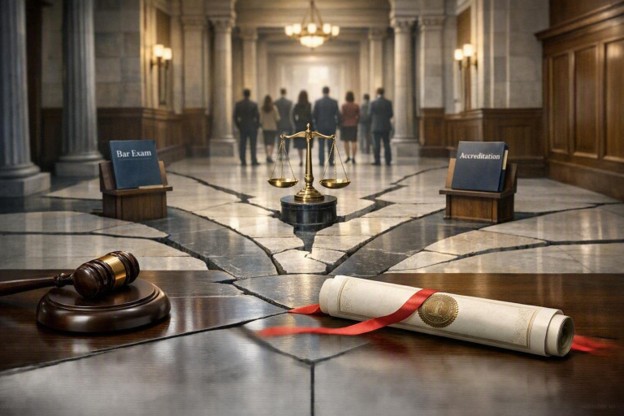
The Association of American Law Schools announced the formation of a National Task Force on the Regulation of American Legal Education. In a news release issued from Washington on August 11, AALS said the fifteen-member panel of judges, legal educators, lawyers and higher education leaders will study how law schools are accredited and how new lawyers are admitted to practice.
The group will issue an initial briefing in fall 2026, followed by a final report and recommendations later in the year, with findings presented at the 2027 AALS Annual Meeting in January.
The roster reflects the stakes. Indiana Chief Justice Loretta H. Rush and Washington Supreme Court Justice Steven C. González serve alongside Stanford Law Dean George G. Triantis, NYU Dean Troy A. McKenzie, and Lynn Pasquerella, president of the American Association of Colleges and Universities. Wendy C. Perdue, former dean at the University of Richmond School of Law, serves as reporter. AccessLex, the Law School Admission Council, NALP and the National Conference of Bar Examiners will serve as informational resources.
“The quality of legal education is inseparable from the quality of justice in America,” said Kellye Y. Testy, CEO and executive director of AALS. The panel’s remit spans accreditation, the quality of legal education, licensure and professional preparation, and it will weigh the effect of newer routes to licensure and of alternative legal service providers.
The Ground Moved First
The task force arrives after several states stopped waiting.
The Texas Supreme Court issued an order in January finalizing a tentative opinion from the prior September, ending the requirement that bar applicants hold a degree from an ABA-accredited law school. Florida’s Supreme Court followed on January 15, concluding it was not in Floridians’ interest for the ABA to be the sole gatekeeper over bar eligibility. Alabama has cut the ABA’s legal education council from its licensure process, and Ohio is reevaluating.
The pressure is federal as well. The council faces a five-year review of its accreditation status by the U.S. Department of Education, which recommended in August that the council lose its federal recognition; a final decision had not been made as of this update. Immediate past council chair Daniel Thies was scheduled to appear before the National Advisory Committee on Institutional Quality and Integrity on September 23 and 24.
That clock drove the fight over Standard 206. The council voted May 15 to repeal the diversity and inclusion standard. On August 4, the House of Delegates declined to concur and sent it back — then adopted a separate resolution cutting the feedback rounds the council owes the House from two to one, leaving the council free to act alone. On September 8, the council did exactly that, voting in a special session to eliminate Standard 206, effective immediately. We documented the full sequence in ABA DEI Rule for U.S. Law Schools Repealed by Council.
Licensure Is Fragmenting Too
The bar exam itself changed this summer. The NextGen Uniform Bar Examination debuted in ten jurisdictions, and per the post-administration report from the National Conference of Bar Examiners, 2,640 examinees completed it across sixteen testing locations. The rollout was not clean: in Washington, 645 applicants could not test after a venue infrastructure failure at the Yakima Convention Center forced cancellation. Thirteen jurisdictions join in July 2027, and NCBE says a total of 52 will begin administering the exam between now and July 2028.
Running parallel are the routes that skip the exam. Oregon’s Supervised Practice Portfolio Examination requires 675 hours of supervised work, eight written work products, two client interaction sessions and two negotiations, all scored by the Board of Bar Examiners. Utah’s alternate pathway requires 240 supervised hours plus a written performance exam administered by the state bar. Nevada went furthest: under rules effective January 19, its licensing exam has four components — the MPRE, a Foundational Law Exam, a Lawyering Performance Exam and a supervised practice requirement. July 2026 was the last administration of Nevada’s old bar exam.
Supervision Becomes a Small-Firm Obligation
These programs run on supervising attorneys, and small firms are where many placements land.
Oregon’s rules spell out the cost. An eligible employer — the bar names solo practitioners and law firms directly — must employ the provisional licensee for at least 20 hours of legal work per week, pay at least the same salary and benefits as other recent graduates, and provide professional liability coverage. Utah requires supervisors to log hours in tenth-of-an-hour increments and attest to their accuracy. That is real unbilled time and real professional exposure, absorbed by firms with no HR department to absorb it.
The client-facing consequence is quieter and larger. Prospective clients will increasingly meet attorneys credentialed through routes they have never heard of, at the moment alternative legal service providers move further into the routine matters that once walked through a small firm’s door. When a license stops working as a clean signal, the burden of demonstrating competence shifts onto the firm.
Firms that have documented their experience and built a findable, credible presence answer that question before a client asks it. Firms that have not will compete on price against entrants with lower overhead. That gap is where Toppe Consulting works.
About Toppe Consulting
Toppe Consulting is a digital marketing agency in South Carolina, working exclusively with solo practitioners and small law firms. As licensure and accreditation rules fragment state by state, we help small practices establish the visibility and demonstrated authority that credentials alone no longer supply.
Our SEO services for law firms develop content matching how prospective clients actually search for legal help, focused on the local searches where small firms compete. Our public relations services for law firms help attorneys earn media coverage and position themselves as trusted voices on the issues shaping their practice areas.
No long-term contracts. Contact Toppe Consulting to start the conversation.
Disclaimer
Toppe Consulting is a marketing and public relations firm, not a law firm. The information in this article is provided for general informational purposes only. It does not constitute legal advice, accreditation guidance, licensure guidance, or a recommendation on any course of action. Toppe Consulting is not affiliated with the Association of American Law Schools, the National Conference of Bar Examiners, the American Bar Association, the U.S. Department of Education, or any state bar or supreme court referenced. Readers seeking legal advice should consult a licensed attorney in their jurisdiction.
About the Author
Jim Toppe is the founder of Toppe Consulting, a digital marketing agency working exclusively with solo practitioners and small law firms. He holds a Master of Science in Management from Clemson University, teaches Business Law and Marketing at Greenville Technical College, and is the publisher of South Carolina Manufacturing, a digital magazine.
Works Cited
- “AALS Announces National Task Force on the Regulation of American Legal Education.” Association of American Law Schools, 11 Aug. 2026. Accessed 11 Aug. 2026.
- “Ten Jurisdictions Complete the Inaugural Administration of the NextGen Uniform Bar Examination.” National Conference of Bar Examiners, 31 July 2026. Accessed 11 Aug. 2026.
- Hill, Julianne. “Law School Diversity Standard Could Be Axed This Month, Despite House of Delegates Opposition.” ABA Journal, 6 Aug. 2026, www.abajournal.com. Accessed 11 Aug. 2026.
- “ABA Accreditation Council Repeals Diversity Standard.” Inside Higher Ed, 8 Sept. 2026, www.insidehighered.com.
- “Supervised Practice Portfolio Examination (SPPE).” Oregon State Bar. Accessed 11 Aug. 2026.
- “Alternate Pathway.” Utah State Bar. Accessed 11 Aug. 2026.
- “Nevada Comprehensive Licensing Examination.” State Bar of Nevada. Accessed 11 Aug. 2026.
- “Legal Ed council moves forward proposals to end diversity standard, allow alternative bar pathways.” ABA Journal, 23 Feb. 2026. (Source for Texas Supreme Court and Florida Supreme Court actions.)
Related Articles
Recent Industry News

Need Content Written by a Human? Meet Joe Toppe

Your Next Client Is Already Searching. Educational Content Is How They Find You.

Greenville’s Bar Is 126 Years Old. Charleston’s Was Already 201 When It Opened
AALS Convenes National Task Force as the Rules for Becoming a Lawyer Come Apart