
Predictive Maintenance ROI in 2026: Can Small Machine Shops Afford NOT to Adopt?
Toppe Consulting – Your Source for Digital News & Trends in the Legal Industry
The math on predictive maintenance has shifted dramatically. What once required six-figure investments now costs less than a skilled machinist’s weekly wages for a small shop to pilot. Meanwhile, the U.S. Department of Energy reports that functional predictive maintenance programs deliver average returns of ten times the initial investment. For machine shop owners still running reactive maintenance strategies, the question is no longer whether they can afford to adopt—it is whether they can afford not to.
The Cost Equation Has Changed
Traditional maintenance approaches follow predictable cost patterns. Reactive maintenance—running equipment until it breaks—costs approximately $18 per horsepower annually when accounting for emergency repairs, overtime labor, rush parts orders, and production losses. Preventive maintenance based on fixed schedules runs about $13 per horsepower. Predictive maintenance, when implemented properly, drops that figure to roughly $9 per horsepower.
Those numbers come from Department of Energy studies, but they only tell part of the story. The real financial impact shows up in what does not happen: catastrophic failures that cascade into secondary equipment damage, missed delivery deadlines that cost customer relationships, and weekend emergency calls that drain overtime budgets.
For a small machine shop calculating AI adoption costs, the entry point has dropped considerably. Retrofit vibration sensors that connect to cloud monitoring platforms cost a few hundred dollars per machine. Subscription-based monitoring services spread ongoing costs over monthly payments rather than requiring capital expenditures. A shop can pilot predictive maintenance on five critical machines for less than one unplanned breakdown typically costs in emergency repairs and lost production.
What the Data Actually Shows
Independent surveys compiled by the Department of Energy indicate functional predictive maintenance programs achieve measurable results across several categories: 25 to 30 percent reduction in maintenance costs, 70 to 75 percent elimination of breakdowns, 35 to 45 percent reduction in downtime, and 20 to 25 percent increase in production capacity.
These are not theoretical projections from laboratory conditions. They reflect aggregated industrial data from facilities that made the transition from reactive or purely preventive approaches to condition-based maintenance strategies.
The Siemens True Cost of Downtime 2024 report confirms these patterns at enterprise scale. Among large manufacturers, average monthly downtime incidents dropped from 42 in 2019 to 25 in 2024. Hours lost to unplanned downtime fell from 39 per month to 27. Nearly half of surveyed firms now maintain dedicated predictive maintenance teams—double the proportion from five years earlier.
The companies investing in predictive capabilities are not doing so for theoretical benefits. They are doing it because the numbers work.
Small Shop Economics
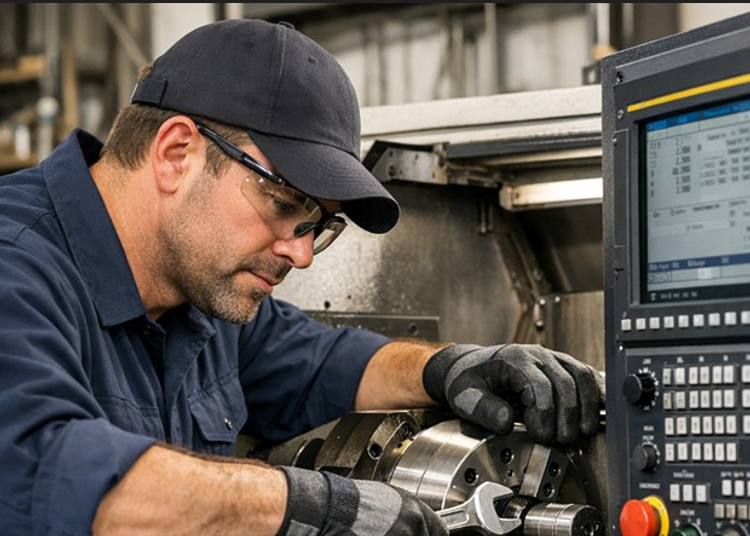
Large manufacturers can absorb occasional equipment failures across multiple production lines. Small machine shops operate with tighter margins and less redundancy. When the main CNC lathe goes down unexpectedly, there is no backup line to pick up the slack. Jobs get delayed. Customers call competitors.
This lack of cushion actually makes predictive maintenance economics more favorable for small shops, not less. The relative impact of preventing one major failure is larger when you have fewer machines and smaller reserves.
Consider a three-machine shop where the primary vertical machining center represents 40 percent of production capacity. An unexpected spindle failure during a critical job run means:
- Emergency repair costs, potentially with weekend or expedited service premiums
- Scrap from parts in progress when failure occurred
- Missed delivery deadlines and potential customer penalties
- Rush shipping costs if parts must be outsourced to meet commitments
- Reputation damage that affects future bidding
A predictive monitoring system that catches spindle bearing degradation two weeks before failure transforms that emergency into a scheduled maintenance event. Parts arrive through normal channels. Repair happens during planned downtime. The job completes on schedule.
Starting Small, Scaling Smart
The most successful small shop implementations follow a staged approach. Rather than attempting to monitor everything simultaneously, they identify the machines where unplanned failures cause the most damage to production schedules and customer relationships.
Rotating equipment—spindles, motors, pumps—provides the clearest return on monitoring investment. Vibration patterns reveal bearing wear, imbalance, misalignment, and looseness weeks or months before these conditions cause failures. Temperature monitoring catches lubrication problems and cooling system issues. Power consumption tracking identifies efficiency degradation.
Start with one or two critical assets. Establish baselines. Learn the monitoring system. Demonstrate value before expanding coverage.
The practical approach to machine shop AI implementation mirrors how successful shops have always adopted new technology: prove it works on a limited basis, then scale based on actual results rather than vendor promises.
Hidden Benefits Beyond Breakdown Prevention
The most obvious benefit—avoiding emergency repairs—represents only part of the financial picture. Predictive maintenance creates secondary advantages that compound over time.
Energy efficiency improves as equipment operates within optimal parameters. Machines developing problems typically consume 10 to 20 percent more power than properly maintained equipment due to increased friction and compensating behaviors. Catching these conditions early reduces utility costs while extending component life.
Quality consistency improves when machines operate within specification. Subtle changes in spindle runout, thermal expansion, or vibration affect surface finish and dimensional accuracy before they trigger obvious failures. Monitoring systems that catch drift early reduce scrap rates and rework requirements.
Institutional knowledge accumulates in monitoring data rather than retiring with experienced operators. When a senior machinist leaves, decades of intuition about how specific machines behave typically walks out the door. Properly configured monitoring systems capture that operational wisdom in data that remains accessible to future staff.
The Labor Shortage Connection
As detailed in our examination of the machine shop labor crisis and AI workforce solutions, predictive maintenance directly addresses staffing challenges. When experienced machinists are increasingly difficult to find and retain, extending the effective reach of available personnel becomes critical.
Monitoring systems that flag developing problems before less experienced operators notice them reduce the supervision burden on senior staff. Junior operators can respond to clear alerts rather than relying on intuition they have not yet developed. Training timelines compress when AI assists the learning process.
For shops struggling to fill positions, predictive maintenance is not just about avoiding breakdowns—it is about making each employee more effective.
Implementation Realities
Vendors naturally emphasize best-case scenarios. Realistic expectations account for learning curves, integration challenges, and the time required to establish meaningful baselines.
Most shops see measurable results within six to twelve months. Initial returns typically come from avoiding one or two significant failures that would have occurred under previous maintenance approaches. Longer-term benefits accumulate as the system learns equipment signatures and operators develop confidence in alert accuracy.
Budget for training time. The most sophisticated monitoring system provides no value if operators ignore alerts or do not understand what they mean. Plan for integration with existing maintenance workflows rather than assuming technology alone changes behavior.
The Competitive Reality
The manufacturing sector is dividing into shops that leverage technology for efficiency gains and shops that compete purely on price. As AI transforms machine shop operations in 2026, the productivity gap between these groups will widen.
Shops with predictive maintenance capabilities can quote jobs more confidently, knowing their equipment reliability supports delivery commitments. They can run tighter schedules without building in excessive buffer time for potential breakdowns. They attract customers who value reliability over lowest price.
Shops without these capabilities increasingly compete with each other for price-sensitive work that more efficient competitors decline. Margins compress. Equipment ages without generating capital for reinvestment. The gap becomes harder to close.
Toppe Consulting Manufacturing Services
Machine shops building competitive advantages through technology need marketing that communicates those capabilities to the right customers. Toppe Consulting helps precision manufacturers showcase their operational excellence through professional websites and targeted digital marketing.
Manufacturing Digital Marketing Services | Contact Toppe Consulting
About the Author
Jim Toppe is the founder of Toppe Consulting, a digital marketing agency specializing in law firms. He holds a Master of Science in Management from Clemson University and teaches Business Law and Marketing at Greenville Technical College. Jim also serves as publisher and editor for South Carolina Manufacturing, a digital magazine. His unique background combines legal knowledge with digital marketing expertise to help attorneys grow their practices through compliant, results-driven strategies.
Works Cited
Association of Electrical and Mechanical Trades. “The True Cost of Downtime 2024: A Comprehensive Analysis.” AEMT, 1 Aug. 2024, www.theaemt.com/resource/the-true-cost-of-downtime-2024-a-comprehensive-analysis.html.
U.S. Department of Energy. “Chapter 5: Types of Maintenance Programs.” O&M Best Practices Guide, Release 3.0, Federal Energy Management Program, www1.eere.energy.gov/femp/pdfs/OM_5.pdf.
Related Articles
Recent Industry News

UnDesked Targets Manufacturing Labor Gap with AI Translation Platform

7 Real worker injuries that’ll make you cringe

Will the Bermuda Triangle Claim Another Victim — and Leave Greenville With Egg on Its Face?
6 Rotten reasons injured workers need an attorney