
2026 AI Forecast for Machine Shops: 5 Changes Every Shop Owner Must Prepare For
Toppe Consulting – Your Source for Digital News & Trends in the Legal Industry
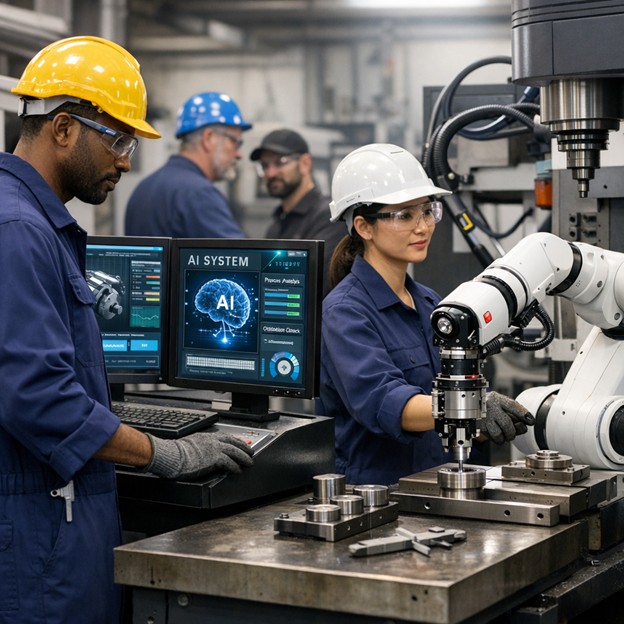
The precision manufacturing sector stands at an inflection point. Three-quarters of manufacturing leaders now expect artificial intelligence to rank among their top three margin contributors by 2026, according to the TCS Future-Ready Manufacturing Study released in December 2025. For machine shop owners watching competitors invest in smart technology, the question is no longer whether to adopt AI—but how quickly they can afford to wait.
The Readiness Gap Creates Opportunity
Despite widespread enthusiasm for AI-driven operations, a significant disconnect exists between ambition and execution. The same TCS study found that only 21% of manufacturers consider themselves fully AI-ready, pointing to persistent challenges in data infrastructure, system integration, and workforce preparation. This gap represents both a warning and an opportunity for smaller shops willing to move strategically.
Machine shops that address foundational issues now—clean data collection, sensor integration, connected equipment—position themselves to capture efficiency gains before larger competitors finish their digital transformations. The manufacturing labor shortage affecting precision shops nationwide makes this timing especially critical.
Five Shifts Reshaping Machine Shop Operations
1. Predictive Maintenance Goes Mainstream
Unplanned downtime remains the single largest productivity killer in precision manufacturing. AI-powered predictive maintenance systems now achieve detection accuracy rates exceeding 90% for equipment failures, allowing shops to schedule repairs during planned windows rather than scrambling after breakdowns occur. Entry-level systems using retrofit sensors and edge computing have dropped implementation costs enough for shops running five or fewer CNC machines to see positive ROI within eighteen months.
2. AI-Assisted CAM Programming Accelerates
Programming time for complex parts continues shrinking as AI learns from historical toolpath data. Newer CAM systems suggest optimal feeds, speeds, and tool selections based on material properties and machine capabilities. Experienced programmers report 30-40% reductions in setup time for repeat jobs, freeing capacity for higher-margin prototype work.
3. Digital Twins Mature for Mid-Size Operations
Virtual replicas of physical machines and processes were once exclusive to aerospace giants and automotive OEMs. Cloud-based platforms now offer digital twin capabilities scaled for shops with annual revenues between $2 million and $20 million. These systems simulate production runs before cutting metal, catching potential collisions, identifying bottlenecks, and optimizing cycle times without consuming spindle hours.
4. Workforce Roles Evolve Rapidly
The Bureau of Labor Statistics projects 34,200 annual openings for machinists and tool-and-die makers through 2034, driven almost entirely by replacement needs as experienced workers retire. Meanwhile, demand for industrial machinery mechanics—the technicians who maintain and repair increasingly sophisticated equipment—is growing 13% over the same period, far outpacing average job growth across all occupations. Machine shops need employees who can operate CNC equipment and troubleshoot the AI systems monitoring that equipment. The machinist of 2026 looks more like an applied computational specialist than a traditional manual tradesperson.
5. Quality Systems Get Smarter
In-process inspection using machine vision and AI-driven analysis catches defects earlier in production runs. Rather than scrapping finished parts that fail final inspection, smart quality systems identify drift before tolerances slip out of specification. Some shops report scrap reductions exceeding 25% after implementing AI-enhanced quality monitoring.
What This Means for Your Shop
The cost of unplanned downtime hits smaller operations hardest because they lack the redundant capacity to absorb production losses. A single unexpected spindle failure during a rush order can cascade into missed deadlines, damaged customer relationships, and lost future business.
AI adoption in machine shops is not about replacing skilled machinists. The technology amplifies what experienced operators already know, extending their expertise across more machines and more shifts than any individual could physically manage. Shops that frame AI as a force multiplier for their existing workforce—rather than a replacement strategy—tend to see faster adoption and better results.
The 79% of manufacturers who acknowledge they are not yet AI-ready face a closing window. Early movers are already capturing efficiency gains that translate directly to competitive pricing and faster turnaround times. Waiting for perfect conditions means watching market share migrate to shops that figured out how to start with imperfect but improving systems.
Toppe Consulting Manufacturing Services
Machine shops investing in AI and automation need customers to understand the value these technologies bring. Toppe Consulting helps precision manufacturers communicate their technological capabilities through professional websites, targeted SEO, and content that speaks to engineers and procurement managers.
Manufacturing Digital Marketing Services | Contact Toppe Consulting
About the Author
Jim Toppe is the founder of Toppe Consulting, a digital marketing agency specializing in law firms. He holds a Master of Science in Management from Clemson University and teaches Business Law and Marketing at Greenville Technical College. Jim also serves as publisher and editor for South Carolina Manufacturing, a digital magazine. His unique background combines legal knowledge with digital marketing expertise to help attorneys grow their practices through compliant, results-driven strategies.
Works Cited
Bureau of Labor Statistics. “Machinists and Tool and Die Makers: Occupational Outlook Handbook.” U.S. Department of Labor, 28 Aug. 2025, www.bls.gov/ooh/production/machinists-and-tool-and-die-makers.htm.
Tata Consultancy Services. “AI Will Be Key Driver for Margin Gains in 2026 finds TCS Future-Ready Manufacturing Study.” TCS Newsroom, 3 Dec. 2025, www.tcs.com/who-we-are/newsroom/press-release/ai-will-be-key-driver-for-margin-gains-in-2026-finds-tcs-future-ready-manufacturing-study.
Related Articles
Recent Industry News

UnDesked Targets Manufacturing Labor Gap with AI Translation Platform

7 Real worker injuries that’ll make you cringe

Will the Bermuda Triangle Claim Another Victim — and Leave Greenville With Egg on Its Face?
6 Rotten reasons injured workers need an attorney