Toppe Consulting – Your Source for Digital News & Trends in the Legal Industry
From Chatbots to Colleagues: Legal AI Evolves
The AI tools most attorneys experimented with over the past two years operated on a simple model: ask a question, get an answer. Request a document summary, receive one. These generative AI assistants required constant human prompting and produced isolated outputs.
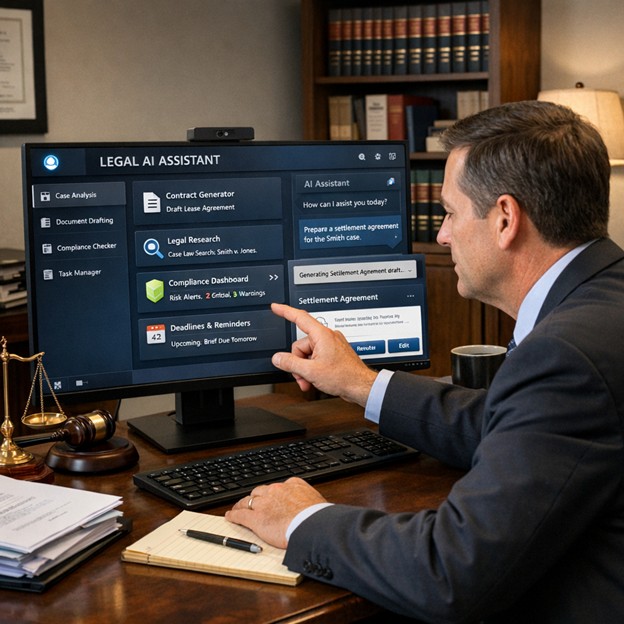
Agentic AI works fundamentally differently. These systems plan multi-step workflows, execute tasks autonomously, and adapt based on results—all while maintaining human oversight at critical decision points. 2026 Legal AI Forecast: 5 Advancements Every Law Firm Must Prepare For examines how this shift fits within the broader transformation reshaping legal practice.
According to Gartner, 40% of enterprise applications will integrate task-specific AI agents by the end of 2026, up from less than 5% in 2025. For law firms, this represents the most significant technology shift since the adoption of cloud computing.
The legal technology market is already responding. Thomson Reuters launched CoCounsel Legal in August 2025 with agentic capabilities that independently plan and execute complex legal research workflows. LexisNexis deployed its Protégé platform with four specialized agents collaborating on research tasks. These are not future concepts—they are production systems available now.
What Makes Agentic AI Different for Law Firms
Traditional AI assistants function like junior associates who complete single tasks when asked. Agentic AI operates more like experienced paralegals who can handle entire projects with appropriate supervision.
Consider a typical discovery request. With traditional AI, an attorney might use separate tools to search documents, summarize findings, identify privileged materials, and draft responses. Each step requires human initiation and review.
An agentic system receives the discovery request, creates a workflow plan, executes document analysis, flags privilege issues, drafts responses, and presents results for attorney review—all from a single instruction. The attorney remains in control but spends time on judgment calls rather than task management.
Thomson Reuters reports that its CoCounsel Legal can now process bulk document review of up to 10,000 documents in a single workflow. For small firms handling complex litigation, this capability fundamentally changes what's possible without expanding headcount.
The Corporate Client Pressure Point
Corporate legal departments are adopting AI faster than their outside counsel—and they are paying attention to the gap.
The 2025 ACC/Everlaw survey found that generative AI adoption among in-house counsel more than doubled in one year, jumping from 23% to 52%. The survey of 657 legal professionals across 30 countries revealed that 64% of in-house teams now expect to rely less on outside counsel because of AI capabilities they are building internally.
Perhaps more concerning for law firms: 59% of in-house teams do not know whether their outside counsel use AI on their matters. This transparency gap creates both risk and opportunity. Firms that can demonstrate AI capabilities and explain how those tools benefit clients gain competitive advantage.
Gloria Lee, Chief Legal Officer at Everlaw, noted that transparency is becoming a requirement rather than a courtesy. Law firms that cannot articulate their AI strategy to clients risk losing work to competitors who can. AI Compliance Deadlines Hit in 2026: Is Your Law Firm Ready? addresses how firms can build compliant AI frameworks that satisfy client demands.
Practical Applications for Small Firms
Solo practitioners and small firms often assume agentic AI is designed for BigLaw budgets. The economics tell a different story.
Large firms already employ armies of associates and paralegals to handle document review, research, and drafting. AI provides incremental efficiency gains on existing capacity. Small firms lack that capacity entirely. AI provides capability that otherwise would not exist.
Research and Drafting: Agentic systems can generate complete research memoranda from a single question, tracing logic through multiple sources and producing citation-backed analysis. Tasks that once required blocking out full days now complete in hours.
Client Intake: AI agents can qualify leads, schedule consultations, and gather preliminary case information around the clock. For solo practitioners who cannot afford dedicated intake staff, this addresses one of the most common client service failures in legal practice.
Document Analysis: Contract review, due diligence, and discovery all involve repetitive analysis across large document sets. Agentic systems handle the volume while attorneys focus on anomalies and strategic issues.
The ABA Tech Survey found that AI adoption among law firms nearly tripled from 11% in 2023 to 30% in 2024, with time savings and increased efficiency cited as primary drivers. Early adopters are establishing competitive advantages that late adopters will struggle to overcome.
Ethical Guardrails Remain Essential
ABA Formal Opinion 512, issued July 29, 2024, established that attorney competence requirements extend to understanding AI capabilities and limitations. Lawyers need not become technical experts, but they must exercise reasonable judgment about when and how to deploy these tools.
Agentic systems introduce additional considerations. When AI operates autonomously across multi-step workflows, attorneys must understand where human oversight checkpoints exist and what decisions the system makes independently.
Key competence requirements include understanding what data the AI accesses, how it reasons through problems, where it might make errors, and what guardrails prevent unauthorized actions. Supervision obligations under Model Rules 5.1 and 5.3 apply to AI systems just as they apply to junior attorneys and paralegals.
Firms deploying agentic AI should document their policies, train staff on appropriate use, and establish review protocols that match the level of autonomy granted to the system.
How Toppe Consulting Supports Your Firm
Toppe Consulting helps law firms build digital infrastructure that integrates with modern AI-enabled practice. Our law firm SEO services ensure potential clients find you online while our website development creates professional presence that supports technology-forward practice.
Ready to prepare your practice for 2026? Contact our team for a free consultation.
About the Author
Jim Toppe is the founder of Toppe Consulting, a digital marketing agency specializing in law firms. He holds a Master of Science in Management from Clemson University and teaches Business Law and Marketing at Greenville Technical College. Jim also serves as publisher and editor for South Carolina Manufacturing, a digital magazine. His unique background combines legal knowledge with digital marketing expertise to help attorneys grow their practices through compliant, results-driven strategies.
Disclaimer
The information presented in this article reflects the opinions of the author based on the research and sources cited. This content is provided for general informational and educational purposes only and does NOT constitute legal advice. Reading this article does not create an attorney-client relationship. Laws vary by jurisdiction and change frequently. For guidance on your specific legal situation, consult a licensed attorney in your area.
Works Cited
"64% of In-House Counsel Expect GenAI to Reduce Reliance on Outside Counsel." Association of Corporate Counsel, 14 Oct. 2025, www.acc.com/about/newsroom/news/acc-genai-report-corporate-law-departments-ai-use-everlaw. Accessed 3 Jan. 2026.
"Gartner Predicts 40% of Enterprise Apps Will Feature Task-Specific AI Agents by 2026." Gartner, 26 Aug. 2025, www.gartner.com/en/newsroom/press-releases/2025-08-26-gartner-predicts-40-percent-of-enterprise-apps-will-feature-task-specific-ai-agents-by-2026-up-from-less-than-5-percent-in-2025. Accessed 3 Jan. 2026.
Related Articles