
2026 Tariffs Are Forcing American Manufacturers to Rethink Everything

Toppe Consulting – Your Source for Digital News & Trends in the Legal Industry
American manufacturers are entering 2026 under pressure not seen since the early pandemic months. Trade uncertainty has displaced every other business concern—workforce shortages, rising material costs, even inflation—to become the dominant force shaping strategic decisions across the manufacturing sector. For companies that built their operations around stable global supply chains, the ground has shifted dramatically, and the path forward requires fundamental changes to how they source, price, and market their capabilities.
The numbers paint a stark picture. According to the Deloitte 2026 Manufacturing Industry Outlook, the Institute for Supply Management’s manufacturing purchasing managers’ index remained below 50 for much of 2025, signaling contraction across the sector. Costs rose while employment fell. Manufacturing construction spending—a key indicator of investment in new or expanded facilities—steadily declined throughout the year. These aren’t temporary disruptions. They represent structural shifts that will define manufacturing competitiveness for years to come.
The pressure intensifies as manufacturers face a July 2026 deadline that could reshape North American trade relationships entirely. The USMCA review, detailed in USMCA Review July 2026: What Every Manufacturer Needs to Know Now, represents either a path to stability or a gateway to further disruption depending on negotiation outcomes.
Why Trade Uncertainty Dominates Every Other Concern
Trade policy uncertainty has topped manufacturers’ concerns for three consecutive quarters, and the intensity keeps building. The National Association of Manufacturers Q2 2025 Outlook Survey revealed that 77 percent of respondents cited trade uncertainty as their primary business concern—a figure that jumped 20 percentage points from late 2024. Only 55.4 percent of manufacturers reported a positive outlook for their companies, the lowest level since the COVID-19 pandemic peak.
The cost impact compounds across every line item. Nearly 90 percent of manufacturers surveyed reported that changes to trade policy have increased their business costs. Average cost increases hit 7.8 percent, with raw material and input costs expected to rise another 5.4 percent over the next year. These aren’t margins most manufacturers can absorb. They’re forcing difficult decisions about pricing, sourcing, and operational restructuring.
For manufacturers who’ve built customer relationships on price stability, the situation creates a marketing crisis alongside the operational one. Customers expect transparency about pricing changes. Competitors who’ve already restructured their supply chains may undercut those still figuring out their approach. The companies that communicate clearly about their value proposition—beyond just price—will maintain customer relationships through this transition.
What Smart Manufacturers Are Doing Differently
The manufacturers weathering this storm share common strategies that extend beyond simple cost-cutting. They’re diversifying supplier networks across regions, reducing dependence on any single source country. They’re investing in automation and smart manufacturing technologies that improve productivity without proportional workforce increases. And critically, they’re communicating these capabilities to customers and prospects who need suppliers that can deliver reliability despite global instability.
Domestic sourcing is surging as manufacturers seek supply chain stability. Understanding the full picture of Reshoring vs. Nearshoring: Which Strategy Actually Protects Your Supply Chain in 2026 helps companies make informed decisions about where to source and how to position those choices as competitive advantages.
The marketing implications matter as much as the operational ones. Manufacturers investing in digital presence, content marketing, and SEO are positioning themselves to capture customers actively searching for suppliers who can deliver despite trade disruptions. When a buyer searches for “domestic manufacturing supplier” or “tariff-proof supply chain partner,” the companies appearing in those results will capture the reshoring wave.
Toppe Consulting: Your Manufacturing Digital Marketing Partner
At Toppe Consulting, we understand that manufacturers need more than website traffic—they need RFQs from qualified buyers actively seeking reliable domestic suppliers. Led by Jim Toppe, who holds a Master of Science in Management from Clemson University and publishes South Carolina Manufacturing, our team combines manufacturing industry knowledge with digital marketing expertise that actually drives results.
Our Services Include:
- Manufacturing Digital Marketing Services – Complete digital marketing solutions designed specifically for manufacturers navigating the current trade environment
Ready to Position Your Company for Growth? Contact Toppe Consulting to discuss how digital marketing can help you capture customers seeking reliable domestic manufacturing partners.
About the Author
Jim Toppe is the founder of Toppe Consulting, a digital marketing agency specializing in law firms. He holds a Master of Science in Management from Clemson University and teaches Business Law and Marketing at Greenville Technical College. Jim also serves as publisher and editor for South Carolina Manufacturing, a digital magazine. His unique background combines legal knowledge with digital marketing expertise to help attorneys grow their practices through compliant, results-driven strategies.
Works Cited
“2026 Manufacturing Industry Outlook.” Deloitte Insights, Deloitte, 13 Nov. 2025, www.deloitte.com/us/en/insights/industry/manufacturing-industrial-products/manufacturing-industry-outlook.html. Accessed 16 Dec. 2025.
“2025 Second Quarter Manufacturers’ Outlook Survey.” National Association of Manufacturers, 30 May 2025, nam.org/2025-second-quarter-manufacturers-outlook-survey/. Accessed 16 Dec. 2025.
Related Articles
Recent Industry News

AALS Convenes National Task Force as the Rules for Becoming a Lawyer Come Apart
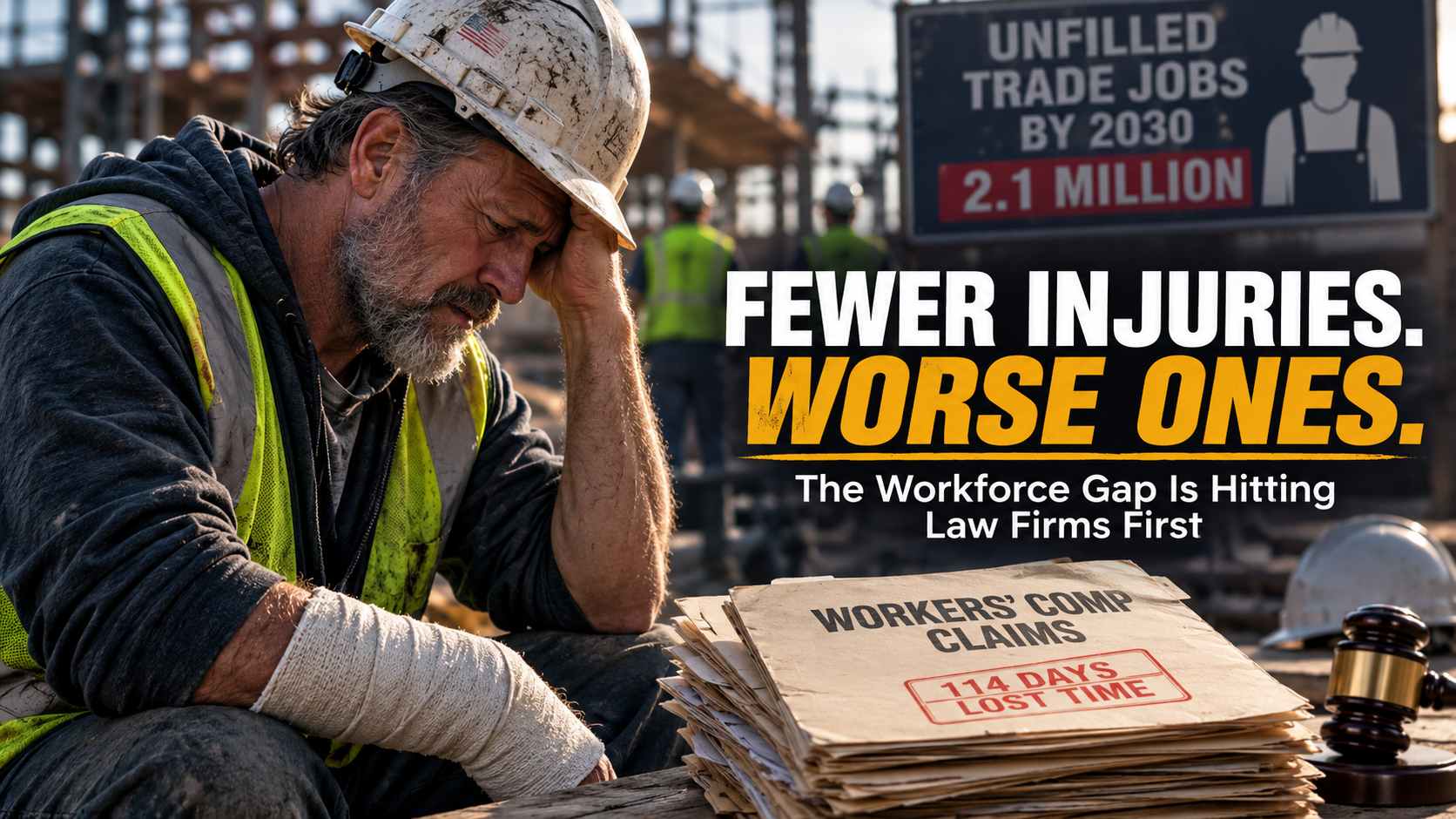
Five Retire, Two Replace: The Trades Gap Is Quietly Rewriting Injury Caseloads

Will the Bermuda Triangle Strike Again?

Civil Legal Aid Faces a Second Straight Year on the Budget Chopping Block